


|
|
|---|


Thursday, January 21, 2010
Ukraine is awaiting a run-off in its presidential election to be held on February 7th between leader of the opposition Viktor Yanukovych and current Prime Minister Yulia Tymoshenko. The winner will succeed President Viktor Yuschenko, who is leaving office with an approval rating in the low single digits, a dramatic fall from grace for the leader of the Orange Revolution. His successor will inherit a country in crisis: economically, financially and existentially. This election could not be more important for Ukraine's future.
Yuschenko's presidency was an utter failure. Granted, he had little domestic support, as his current prime minister (Tymoshenko) is also his fiercest political rival. But his economic record has been dismal in response to the Ukraine's crisis, sacrificing his early achievements in attracting FDI and cutting unemployment. While he has succeeded in turning Ukraine away from Russia and set the country on a path towards European integration (WTO accession, a promise of future NATO membership and negotiations over an FTA with Brussels), he has also presided over near-annual gas wars with Russia that threaten Europe's supplies, a total economic deterioration (GDP contracted about 15% in 2009) and non-observance of key conditions to Ukraine's $16.4 billion IMF program. This led the IMF to suspend its fourth disbursement or $3.8 billion, leaving Ukraine on the brink of default. Yuschenko also managed to swing public opinion decisively against NATO and EU accession, undermining his key foreign policy successes.
Conventional wisdom therefore interprets the current election as a repudiation of Yuschenko's pro-Western agenda, with the two leading candidates representing a more Russia-oriented foreign policy in the years ahead. But according to Samuel Charap's recent article in Foreign Policy, this assumption overstates the degree to which either Yanukovych or Tymoshenko will turn to Russia. Neither candidate is a 'pro-Russian stooge,' even Yanukovych, who according to Charap did little to endear himself to the Kremlin during his stint as prime minister, even if he was the Kremlin's 'preferred' candidate the last time around. Further, the interests that back Yanukovych are heavily invested in EU trade, so one can expect a lot of pressure on the potential president to deepen Ukraine's economic integration into Europe. This is far more critical to Ukraine's future than the immediate prospects for NATO accession.
Tymoshenko's presidency would hold the most promise, as she is likely to fashion a commanding political majority that would leave her free to enact key economic policy reforms, most importantly the 2010 budget and energy sector reform, that would unlock the remaining IMF funds and set Ukraine on a path to recovery. She would also prioritize Ukraine's relationship with Russia, but in the interest of rapprochement, which is as important to Europe (see: gas) as it is to Russia. Thus, both candidates are likely to conduct a more balanced foreign policy, which would be in the interest of all parties. But economics will determine Ukraine's future, and neither candidate can afford to ignore the pressing challenges at home. Both the EU and Russia have a role to play in stabilizing Ukraine's economy.
One of the fundamental insights of IPE is that domestic politics matter as much in the international arena as they do internally. They either enable or constrain foreign policy decisions, and Ukraine's current situation highlights this perfectly. The EU/Russia dichotomy that Yuschenko spent so much time constructing has clouded our perspective on the current candidates and their impact on Ukraine's future, as Charap's article illustrates. Their presidencies will be dominated by jobs, energy and trade. Rapprochement with Russia is likely and welcome, but there are powerful interest groups in favor of further economic integration with the EU. This will check any drift eastward.
Thursday, December 3, 2009
As an addendum to Dave's post below, if you are interested in learning about the current debate/questions surrounding sovereign ratings, have a look at the case of Mexico.
Fitch downgraded Mexico on November 23rd following the Congress' approval of the 2010 budget, which relied too heavily on borrowing and higher oil exports. Mexico's medium-term outlook is under scrutiny, in part, due to the country's over-reliance on a collapsing oil sector (output has declined by about a quarter since 2004, while the sector accounts for almost 40% of state revenue) and failure to sufficiently address the root causes of a widening fiscal deficit, including over-reliance of oil revenues and a small non-oil tax base. JPMorgan has estimated the budget deficit will swell to its widest margin in two decades.
Highlighting the current debate over sovereign ratings, however, is the fact that not everyone agreed with the downgrade. Goldman Sachs' chief Latin American economist Paulo Leme has called the downgrade 'unnecessary roughness' because it overlooks what is still a deficit equivalent to just under 2% of GDP in a recessionary economy. While each country's conditions are different, as a generic measurement a deficit under 4-5% of GDP is widely considered sustainable, especially within the context of a 7.5% annual decline in GDP. I can think of a few countries who would welcome such a small gap. Further, while Leme concedes the Congress could have done far more with the 2010 budget, he feels the downgrade overlooks the value of tax increases included in the bill. The political environment in Mexico is hardly conducive to reform, as Fitch cited as a major factor in its decision, so in this context the tax increases should be viewed as a positive development.
In my opinion, the medium-term concerns centered on the inability of the Calderon government to win Congress' approval for the restructuring of the oil sector are valid, and until this is achieved the country will remain under just scrutiny. But with respect to Mexico's ratings, this assessment places too great an emphasis on medium-term policy considerations, while overlooking the fairly stable near-term profile. Fitch correctly highlights Mexico's vulnerability to future oil-price shocks- relative to its peers Mexico's external debt-to-GDP and debt-to-revenue ratios are high- and limited room for counter-cyclical expansion. But when judged independent of its peers, a downgrade is likely a step too harsh given Mexico's 'healthy banking sector, resilient external accounts, the sovereign's manageable external debt amortization profile, as well as its ability to tap the IMF Flexible Credit Line (FCL) in case of a significant worsening of external financial conditions.' In fact, both the peso and Mexico's bonds rallied following the downgrade, perhaps reflecting a general skepticism amongst market participants.
The case of Mexico illustrates the tricky business of rating sovereign debt and fiscal sustainability, particularly in the post-crisis environment (i.e. widening fiscal deficits amidst tighter borrowing conditions.) While any credit rating agency will tell you that ratings criteria, however objective, are measured within a local context, it seems that in the current environment countries are being painted with rather broad strokes. The spike in CDS spreads for Gulf states following Dubai's announcement is one such example that wholly ignored the unique characteristics of the Dubai situation. The expansionary response of many governments to the crisis has been almost universally credited with averting a total collapse of the global economy. In fact, both the IMF and UN have recently warned against withdrawing this stimulus too soon, lest we manufacture a double-dip recession. While these policies ultimately raise important questions over the medium-term sustainability of imbalances, a clear assessment of a country's ability to exit this response and address larger deficits in the medium-term should control the outlook for a country when, like Mexico, that country is comfortably financing their deficits in the near-term. That picture isn't always clear in the current environment and ratings agencies should thus reserve their judgement until government's are sufficiently confident that growth is sustainable (which they aren't) and have been able to clearly outline their exit strategies (which they haven't.)
Thursday, October 8, 2009
The IMF meetings in Istanbul are something of a victory lap following what many consider a banner year for the Fund. Faced with questions of relevancy just two years ago, the Fund is now globally lauded for its role in fighting fires from Pakistan to Ukraine. While critical questions remain over funding and governance, the IMF looks certain to assume a central role in the post-crisis global financial regulatory regime.
Which makes a new paper out of the Centre for Economic Policy and Research (CEPR) particularly interesting. The think tank argues that, far from helping 31 borrowing countries avert depression, the Fund may actually have made their crises worse.
"More than a decade after the Asian Economic Crisis brought world attention to major IMF policy mistakes, the IMF is still making similar mistakes in many countries," CEPR Co-Director and lead author of the paper, economist Mark Weisbrot said. "The IMF supports fiscal stimulus and expansionary policies in the rich countries, but has a much different attitude toward low-and-middle income countries."
"The CEPR reaches seriously misleading conclusions about the pro-cyclicality of policies in IMF-supported programmes, relying on faulty analysis and often inaccurate information.
"The main point of this report is that growth forecasts were too optimistic when programs were designed, leading to excessively tight fiscal and monetary policies. Reality is quite the opposite.
"In virtually all programmes, fiscal targets were quickly and substantially relaxed once the extent of the crisis became apparent. Monetary and fiscal policies have deliberately sought to offset the fall in global demand."
I agree with the Fund. For one, the argument that the Fund's performance is overshadowed by its failure to forecast the crisis is intellectually weak. Just about everyone failed to foresee the extent of the crisis. The Fund's GDP forecasts were in many cases optimistic, but it was highlighting the severity of the crisis well before many big governments. And who is to say that government's would have independently acted sooner had the Fund taken an even more pessimistic line. That's a pretty easy answer: they wouldn't have.Second, I can't challenge the CEPRs analysis of 41 different arrangements, but I'm pretty sure the Fund's flexibility and counter-cyclical recommendations during the crisis are widely recognized (and applauded), and not just in developed countries. Dominique Strauss-Kahn was calling for fiscal stimulus in early 2008, well before most government's threw-out the neoclassical handbook. The flexible credit facility is downright revolutionary given the Fund's recent history. And even you identify strict conditionality in certain arrangements, I would argue that governments like Ukraine still need to swallow the bitter pill that the IMF is uniquely positioned to provide. The Fund's historical failures are more the result of its inflexible, dogmatic approach, less in the particular conditions it attaches to loans.
No international institution can walk away from this crisis with clean hands. As a pillar of the prior regime, the Fund should be critiqued for its role in fostering the conditions that led to the great unraveling. But its crisis performance was a net success (for now), and the CEPR misses this by wading too far into the weeds.
Wednesday, May 27, 2009
-Iraq's Commission on Public Integrity has announced that it is issuing approximately 1,000 arrest-warrants for government officials on corruption-related offenses. This massive purge is said to include upwards of 53 senior officials (director-general level or above), and is largely centered around the Ministry of Trade. The trade minister, Abdul Falah Sudani, resigned on Monday ahead of a no-confidence vote in parliament. Obviously, warrants and investigations are far easier to announce than actual convictions, particularly of high-ranking officials. But I find this announcement stunning on two levels: for one, its sheer scale is incredible. Never mind the anti-corruption records of (post-sectarian conflict) developing countries; in what developed country can you find such broad accountability in government? Britain is the only country that comes to mind in recent years, and even there the current expenses scandal is defined by public shame and resignation, rather than actual corruption charges (remember, MPs never actually "broke the law"). Second, the Ministry of Trade is dominated by the Dalawi faction of Prime Minister Nuri al-Malaki; the Iraqi PM is leading a massive anti-corruption investigation centered on his own political fiefdom. That is perhaps the most remarkable aspect of all.
-How concerned should we be that Russia is currently preparing for nuclear conflict on the Korean peninsula?
-Hizbollah is reportedly in talks with both the IMF and EU to safeguard Lebanon's external funding in the event of an election victory by the Shia group on June 7.
-The Economist examines the Obama Administration's first climate-change bill.
-The next big foreign target of Chinese investors is...LeBron James?
Tuesday, April 14, 2009
Poland looks set to become the second country, after Mexico, to access the IMF's Flexible Credit Line, a facility designed to offer stable countries access to contingency credit with few strings attached.
Polish Finance Minister Jacek Rostowski was careful to point out that the credit line would be treated as a "supplementary reserve" for the central bank, rather than "emergency funding."
Sunday, April 5, 2009
Politique
-The G20 reached deals on IMF funding, tax havens and trade finance. Bretton Woods it was not, but a productive start?
-North Korea launches an intercontinental ballistic missile (er, satellite), world condemns and an emergency security council meeting is called for Sunday at the UN.
-NATO agrees on a troop surge to Afghanistan, Rasmussen for Secretary-General.
Economia
-Mexico became the first country to seek access to the IMF's new no-strings-attached lending facility.
-The ECB cuts rates again and Trichet signals the possibility of unconventional measures to come.
-The mark-to-market rule is amended in the US, financial stocks soar.
The Rest
-In the Prem, Liverpool go top, Fab and Adebayor solidify Arsenal's hold on 4 in their return to action, while Shearer's big return to Saint James' Park is business as usual for the Magpies.
-Honda's new robotic helmet reads your mind. Matrix or Terminator?
-An Antarctic ice bridge the size of Jamaica has snapped.
Thursday, April 2, 2009
George Soros makes a great point:Institutions such as the International Monetary Fund face a novel task: to protect the periphery countries from a storm created in the developed world. Global institutions are used to dealing with governments; now they must deal with the collapse of the private sector. If they fail to do so, the periphery economies will suffer even more than those at the centre.
Soros then goes on to point out how differing perspectives about the financial crisis on both sides of the Atlantic threaten to derail any substantial progress in upgrading our international financial institutions. But he's only telling one-half of the story.
Yes it's true that the IMF needs more resources, but it also needs customers. The problem is both the stigma attached to countries that go to the IMF cap-in-hand and the strings attached to IMF loans. These are two of the mains reasons why the East Asian economies have built up very large currency reserves: applying for an IMF loan is punished by market actors that interpret such activity as a sign of weakness (not prudence), and is "punished" by the IMF in the form of disruptive policy reforms.
Recognizing this problem, the IMF has just launched a new Flexible Credit Line (FCL) that is specifically designed for "countries with very strong fundamentals, policies, and track records of policy implementation." It has considerably fewer strings attached and is aimed at being a precautionary tool, rather than a last resort. But the optics problem remains and countries are reluctant to apply.
Until yesterday, that is. Mexico is seeking $47 billion under the FCL to act as a buffer against the fallout from the financial crisis. In other words, Mexico has bravely volunteered itself to test how the market will react to the IMF providing pre-emptive financial assistance to a country that has their "strong fundamentals" stamp of approval. Has the financial crisis caused such an upheaval in the market mentality that this prudence will be rewarded? Or are serious investors unconvinced of Mexico's "fundamentals" and going to punish it just like old times?
According to the FT, the final G20 communique makes the easy choices, and avoids almost all the tough ones (unless you ever really considered tax havens a sticking point). Gordon Brown is currently holding his closing press conference, putting a brave face on the meeting. Here are the preliminary details, keeping in mind that I have not read the communique yet:
-$750bn increased funding for the IMF ($500bn in new loans, $250bn creation of a new special drawing rights facility)
-$250bn in trade finance
-OECD to publish list of tax havens to "name and shame"
-Hedge funds will come under the direct supervision of national regulators
So, where do we stand? Well, the Europeans seem to be the big winners. The EU got its tax havens/hedge fund regulation, increased IMF funding and international trade support. We have no "grand bargain" on global financial regulation, but that was always as unlikely as a stimulus commitment. Sarko's showmanship seems to have worked; another successful summit for the great Summit Sarko.
I must say that the US/UK largely failed to obtain its priorities, especially a global commitment on fiscal stimulus. In his closing presser, Brown boasted of historic interest rate cuts and a global fiscal stimulus. But this was a classic summit tactic of framing actions already taken by national governments in the context of the summit consensus; when, in fact, no such consensus exists moving forward.
We will have much more to say about the G20 communique once we dive into the details. But initially, the agreement does seem pretty unremarkable, and the global fault lines appear as deep as they were heading in.
Wednesday, April 1, 2009
Other, traditional media outlets will provide you with more comprehensive coverage of the G20 meeting in London. While a lot of bloggers would have you believe otherwise, newspapers still offer the best access, authority and overall coverage of events like the G20. I have no illusions to the contrary. So over the next few days, I'll instead aim to provide our readers with some of the more interesting, hilarious and overlooked anecdotes of this important meeting.
-It is fascinating to watch the public relations machines in overdrive ahead of the meeting: downplay the differences (US, UK), demand your red lines are met 'or else' (France, Germany), the other side just doesn't get it (Japan), mumble about the dollar to avoid taking a vocal stance on the most controversial issues (Russia, China), sit back and avoid the collateral damage (everyone else). Summits are always about image/message management, and unfortunately only rarely about radical or decisive action. As a colleague noted to me this week, 90% of a multilateral summit is completed before the principals even sit down at the table (sherpas do the heavy lifting in advance of the meeting itself). Each leader knows this, and thus positions him/herself accordingly ahead of the final communique, speaking directly to their domestic audience. The fact that such deep divisions are so publicly aired ahead of this particular summit suggests that there will be few major breakthroughs in London. Regardless of the post-summit rhetoric, increasing the regulation of hedge funds, while important, isn't going to solve any of our most immediate problems. Increasing IMF funding would occur with or without this meeting.
-The City of London was fighting back!! ahead of the protests, although I wonder how many are actually hanging around Bank and Moorgate after work this evening.
-Dan Drezner's April Fool's Day joke would be a lot funnier if it wasn't so, sadly, improbable.
-For two leaders with a chilly relationship, Merkel and Sarko have forged quite the formidable alliance at this summit. This front was built on tax havens in Europe and seems to be carrying through quite strongly to global financial regulation.
-Sarkozy, in fact, claimed today that China was the main obstacle to a deal on global regulation, blocking a provision on...wait for it...tax havens (which, by relation, is an issue directly connected to hedge fund regulation). Who would have guessed that tiny alpine kingdoms, English Channel rock formations and tropical islands would collectively sink a summit? And does it not seem a little too convenient for China to be cast as the problem when such deep divisions exist between the US/UK and France/Germany?
Tuesday, March 17, 2009
especially in Britain and Japan. The report was penned by a top aide to IMF Managing Director Dominique Strauss-Kahn, and projects a global economic contraction well into 2010. Among the most startling figures:
-The UK will shrink by 3.8% in 2009, its biggest annual contraction since 1944. It will contract a further 0.2% in 2010.
-Japan will contract by 5.o%, Eurozone by 3.8%, US by 2.6% and the G7 as a whole by 3.2% in 2009.
-The US will eke out 0.2% growth in 2010 (Hooray! Growth!).
Buckle down ladies and gents, we're in for a long slog.
Monday, February 9, 2009
-Robert Mugabe declares, "Let them eat cake!"
-Ukraine has all but abandoned compliance with the conditions of its $16.5bn IMF standby facility. According to the FT, Ukraine has sent letters to a number of countries (US, Russia, China, EU, Japan) requesting emergency loans to plug a revenue shortfall. Kiev's unwillingness to balance the 2009 budget and cut deficit spending alarmed an IMF delegation last week, who warned of "serious problems" in Ukraine's economy. It is unclear how this visit will affect further disbursements of IMF funds.
-In a VoxEu article, Jeffry Frieden looks at the difficult balancing act policymakers must navigate in building domestic support for international cooperation in response to the worsening economic crisis.
-Ahead of the Treasury Secretary's official announcement tomorrow, the NYT is reporting that Timothy Geithner prevailed over top administration aids calling for stricter conditions in the second banking bailout. Geithner was reportedly concerned that too much government intervention would discourage private investors from participating and increase the cost to taxpayers in the long run.
-Jonah Lehrer at the great science blog The Frontal Cortex asks: why can't Federer beat Nadal? Conventional wisdom is that tennis is a young man's game and 28 is the apex of every great career. As Federer hits that wall (he turns 28 in August), his decline is all but inevitable. But Lehrer points to the post-30 performance of great athletes in sports like basketball or track and field as proof that the body doesn't necessarily decay in our late 20's. So what's unique about tennis? Lehrer echoes my own observation following Federer's post-Aussie tear fest: its mental.
So what happens to tennis stars? Why can Federer no longer defeat Nadal? I'm guessing performance anxiety. I think tennis, perhaps more than any other sport, is a game of self-confidence. Unforced errors are inevitable - the margin for error when hitting a ball that fast with a metal racket is simply too small. The question is how you deal with these mistakes. Players with swagger - say, the Federer of 2006-2007 or the Nadal of now - brush off their errors and come back with an ace. With age, however, comes the nagging tremors of self-doubt. When I watch the Federer of 2009 I see a player who no longer knows he's the best - his face occasionally betrays anxiety and insecurity. The end result is a dangerous form of self-consciousness, as Federer starts thinking too much about his serve, or that backhand whip shot, or his forehand down the line. Why aren't his shots going in? Why is his serve 5 mph slower? Why can't he beat this annoying young Spaniard in the capri pants?
The problem with such reflections is that tennis needs to be played on auto-pilot. Once you start thinking about your shots - and I think Federer is especially self-conscious when playing against Nadal - you lose the necessary fluidity and grace. These deliberate thoughts - the by-product of age-related insecurity - interfere with the trained movements of our muscles, so that we start regressing on the court. When players worry about not hitting a shot in, they're bound to hit it out. Federer doesn't need a new trainer: he needs a shrink.
Thursday, January 29, 2009
Today's statistical indicator has been brought to you by the Institute of International Finance, an association of financial institutions. 82% is the projected decline in private capital flows to emerging market (EM) economies in 2009, compared to 2007 (full report here). They now estimate flows of $165 billion, compared to $466 billion last year and $929 billion during the boom year of 2007. That's quite a drop.
Particularly hard hit will be Eastern Europe and Russia - countries that rely heavily upon external financing. Also interesting is their set of explanations for how emerging market financial institutions were hit so heavily last fall despite the fact that they weren't badly exposed to mature-market lenders. It shows very clea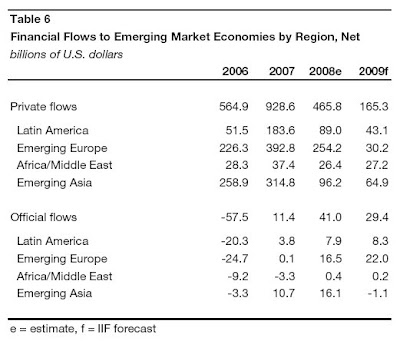 rly how financial problems in one part of the world can filter throughout global credit markets quite easily.
Furthermore, there is a danger that emerging markets in need of financing will be "crowded out" by the now massive borrowing needs of the G7 countries. Despite the huge amounts of debt they are taking on, the returns on bonds of G7 countries are still fairly low, indicating that investors still consider them safer than the alternatives. One of those alternatives is, of course, emerging markets.
The good news, according to this report, is that financial surpluses from earlier growth is giving EM economies more space for counter-cyclical monetary and fiscal policies. Moreover, while the commodity boom-now-bust has hurt some (oil-producing) EM economies hard, it's making the recovery of other (oil-consuming) EM economies easier.
But overall, the report suggests that things are looking pretty fragile, particularly for governments with little or no access to international debt markets (Argentina, Venezuela, Ecuador, Hungary, and others). This means that there will be greater need for official lending from the IMF (which has already stepped up to the plate with a whole range of new programs) as well as financing from regional development banks and bilateral agreements.
So just as private lenders in G7 economies have seized up, leaving the responsibility for economic recovery upon the shoulders of governments, so it will have to be with EM economies. Let's just hope that our official lenders are up to the task. If not, they should be given the tools they require.
(Table taken from p.7 of quoted report)
Tuesday, December 30, 2008
IPE Journal looks back at the political events, people and trends that defined our world in 2008.
- The worst financial crisis since the Great Depression sets in motion a paradigm shift in global power and authority. The state reoccupied the commanding heights of the global economy through stimulus packages, banking nationalizations and automotive bailouts. The IMF regained relevance, and political fortunes were turned in response to the crisis. The G20 replaced the G8 (but for how long?), and the WTO sadly threw in the towel for 2008.
- Barack Obama was elected the 44th President of the United States in one of the largest electoral landslides in decades. He is the first African-American elected to the highest office. He quickly established a "team of rivals" cabinet, bringing together the best, brightest and (slightly) bipartisan to implement his foreign policy and economic agenda. This agenda will likely be defined by what has been called a "21st century New Deal".
- Russia invaded and briefly occupied much of Georgia. The conflict reasserted Russian influence in its "near abroad", exposed EU divisions over Russian relations and raised tensions over NATO expansion and US missile defense in Eastern Europe. It also exposed the real power dynamics in Russia, with Putin effectively orchestrating, commanding and negotiating throughout the conflict. However, by the end of 2008, the financial crisis would for the first time raise questions over Putin's rule as the country was forced to devalue the rouble and ripples of unrest began to sprout up.
- Parts of Africa continue their descent into hell. Kenya erupts, Somalia struggles, and Darfur is a humanitarian disaster. Fighting has resumed in the DRC with Rwandan support, and Mugabe has maintained his iron grip on power, squeezing Zimbabwe dry in the process. Mbeki left office in South Africa, paving the way for Zuma in 2009. The world now looks to Ghana in the final days of 2008, and hopes for a victory for African democracy.
- The Treaty of Lisbon, an attempt to streamline and bolster the EU, is rejected by Irish voters, temporarily killing the process. While certainly a setback for further European integration, Europhiles promise to continue holding referendums until the voters get it "right." A December summit laid out the blueprint/compromise for Lisbon's revival in 2009, and, for possibly the first time in EU history, ended with universal praise of a French president.
- Attacks in Mumbai: as of yet, not a defining geopolitical event since Pakistan and India worked hard to prevent the situation from escalating. Nevertheless, this is a potential touching-off point for the nuclear rivals in 2009. It also might (by design??) divert Pakistani attention away from fighting terrorism in the northwest tribal areas, and reignite violence in Kashmir. The implications of Mumbai are vast, and potentially destabilizing for the entire world.
- Israel, in response to repeated rocket attacks, and in advance of national elections, pounds Hamas and infrastructure in Gaza. The year's final week produced one its most explosive events, as the fighting in Gaza risks wider political instability and a humanitarian crisis in the territory. Many analysts believe that Israel's overwhelming aerial assault is an attempt to dictate a new truce with Hamas, but its military establishment is signalling that the shock and awe may be only the first phase in a wider operation aimed at removing Hamas from power.
***Co-written by Dave Hart
Sunday, November 16, 2008
As most well-informed observers were stressing all week, yesterday's G20 meeting in Washington was not going to lead to new financial architecture for the glo bal economic system. "Bretton Woods, the Sequel," this ain't. For one, it was not taking place in the New Hampshire hotel after which the original conference was named (see photo). For two, this meeting was not complemented by several years of preparatory groundwork or by unilateral American leadership coming on the heels of a paradigm-shifting depression and world war. So maybe Mr. Brown and Mr. Sarkozy were getting ahead of themselves with all of their blustery rhetoric.
Now, as is expected for these types of events, the G20 meeting produced a declaration (available here) that contained a fair bit of vague language on what the world leaders are going to do to a) address the current crisis and b) fortify the financial architecture to prevent a repeat performance. But the meeting did produce one, large, significant shift in the way our global economy will be governed in the near future: the G20 appears to have taken over from the outdated G7/G8. On this point, the punditry appears to be unanimous. This is important because the G20 includes powerful emerging economies like Brazil, China, India, Indonesia and Turkey.
This shift is long overdue, but will necessarily make international negotiations that much more difficult. As I alluded to above, the successful completion of the original B.Woods in 1944 was in large part due to the ability of the United States to push its agenda forward unilaterally. Had the Brits not been so crippled by the war, they surely would not have ratified the agreement. It should be clear that, 60 years on, there remain important philosophical differences between the Americans and Europeans on financial governance. Insert China and India into the mix and things become more complicated. But global financial governance is complicated and excluding these countries is a non-starter.
The agenda for the G20 membership from now until the next meeting in April 2009 is to make progress on a number of fronts. Highlights:
- Reform of the World Bank and International Monetary Fund to be more representative of the distribution of economic power (not new).
- Expand the membership of the Financial Stability Forum to include G20 members (relatively new). The FSF is a body that combines governments and international regulatory agencies to establish "best practices" in everything from accounting to insurance.
- Members have agreed to undergo a financial checkup by the IMF and increase funding for IMF lending programs to crisis-stricken countries (that's right, the IMF is relevant again).
- Various other sensible, but hardly revolutionary, promises to beef up financial supervision.
- And finally, a promise to deal with the fact that the Doha round of trade negotiations is dead. It has ceased to be. Bereft of life, it rests in peace. It's bleeding demised. It has rung down the curtain and joined the choir invisible...


