


|
|
|---|


Wednesday, March 16, 2011
 Mrs. Blumenthal, 55, of Florida, has been driving around the city for hours now. Since landing at O'Hare, she's taken in the fleeting sights of the northern and western neighborhoods. This afternoon, she'll barrel along the inexorable super-linearity of Western Avenue all the way down to the city limit before making a U-turn and returning to her hotel for the night. Tomorrow and for the rest of the week, she'll make the same perambulations.
Meanwhile, at a cavernous control room in one of the buildings at the Illinois Medical Super-Complex, doctors and technicians have been monitoring her driving through a mesh network of surveillance cameras scoping for the early tell-tale signs of a neurodegenerative disease. Every micro murmuration, every nano-flux, every subtle correction in her navigation is being recorded. Every speed, every acceleration, every direction — indeed her every reaction to this city turned diagnostic tool will be plotted. Then her medical tour of Chicago will be data mined.
At the end of the week, she'll be given her diagnoses report, although her consultation with the doctors will be a little hurried, as the FBI will be taking over the network for their annual probe for pederastic and terrorist behaviors.
Wednesday, November 10, 2010


Thursday, November 4, 2010
Deep Space Public Lighting, Chilean Copper-Gold Mines, Rare Earths Geopolitics, and iPhones as Portable Artificial Suns
at 6:08 PM
For the past few months, I-Weather.org, developed by Philippe Rahm and fabric | ch, has been churning up a pastel maelstrom here on this blog for use by our spatially and temporally displaced readers to restore their circadian rhythms, whether this is actually possible or not. You, too, can embed this artificial sun on your website to blast your asynchronous readers into metabolic normality. Its open source code is freely available.
At the recent 01SJ Biennial in San Jose, California, we saw a less earthbound and less private platform for this quasi-light therapy: a flickering light tower for “confined and conditioned environments of space exploration vehicles” and “speculative public spaces of distant colonies.”
To distribute and synchronize these pockets of simulant terrestrial cycles of day and night across vast distances, fabrica | ch proposes using a theoretical Deep Space Internet.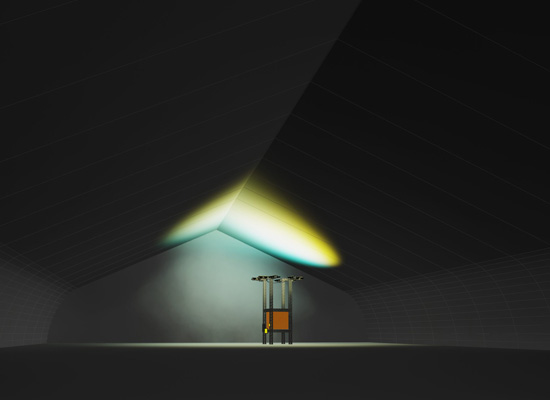

By happy coincide, we first learned about this project just as the first reports about the trapped miners in Chile started trickling in to our attention, specifically, the news that NASA scientists have been flown in by the Chilean government to offer advice on how to help the men stay physically and mentally healthy during the weeks-long rescue.
Al Holland, a NASA psychologist, says during a press conference:
One of the things that's being recommended is that there be one place, a community area, which is always lighted. And then you have a second area which is always dark for sleep, and then you have a third area which is work, doing the mining, and the shifts can migrate through these geographic locations within the mine and, in that way, regulate the daylight cycle of the shift.
It occurred to us that one should make a portable version of Deep Space Public Lighting for future mining disasters. It should be able to fit through bore holes and then easily assembled by survivors in the murky depths of a collapsed tunnel.
A deployable piazza for subterranean “distant colonies.”

Rather than being illuminated by the anemic brightness of a hard hat or video camera, one bathes in soothing electromagnetic wavelengths from a technicolor torch.
Or from an i-weatherized iPhone.

And yes, considering the high demand for coal and industrial minerals, there will be many more mining disasters, many more trapped miners and, depending on various fortunate circumstances, more tunnels to be reconfigured. In fact, only a few days after the last Chilean miner was brought to the surface, 11 miners were trapped at a coal mine in China after a deadly explosion.
Consider, too, the recent export ban by China on shipment of rare earth elements to Japan after a kerfuffle between the two countries involving a collision between a Chinese fishing trawler and Japanese Coast Guard patrol boats near some disputed islands. The ban may have been brief, and China may have denied having instituted one in the first place, nevertheless, the incident points again that China is willing to use its near resource monopoly of rare earth metals as a political tool, to get its way, in other words. Other countries have again taken notice, and are scrambling to develop alternative sources, if not already, to ensure future supply. With new mines opening and even old mine operations being restarted, there are more potentials for disasters.
Reformatted in this context, Deep (Inner) Space Public Lighting engages not just with issues such as “public space, public data, public technology and artificial climate” but also with the geopolitics of natural resources, globalization and our collective networked boredom that seemingly can only be satiated by an epic spectacle of natural and man-made disasters and the ensuing heroic rescue of survivors.
Saturday, October 16, 2010


Wednesday, August 11, 2010

Beneath the city is the world's largest and most powerful particle accelerator, interlocking or in tangents with the next dozen on the list of the highest-energy accelerators.
Everyday they collide particles to produce a steady supply of Higgs bosons, which are stabilized, concentrated and routed as a beam to one of the many gantries located throughout the city. Able to rotate 360º, each three-story gantry can shoot the subatomic particle beam in the correct angle at the cancer patient lying inside its treatment chamber. Precisely calibrated, the Higgs bosons decay the moment they hit the tumor, and in the process of decaying or escaping into other dimensions, they degrade the mutant cells.
This super-machine, then, is one giant medical device, the most expensive in the history of medicine. It's also the most costliest to use. A second under its therapeutic beam can bankrupt a small nation. In the aftermath of the repeal of health care reform acts, treatment regimes have leapfrogged into mindboggling territory.
Practically everyone in the metropolitan area is employed to support these machines, either as administrators, research scientists, the army of engineers who maintain and repair the thousands of complex parts strewn throughout the city, the security staff who police the miles of tunnels and profile saboteurs, or the cooks who feed them all.
The infrastructure to generate their massive energy requirements might as well be another city, complete with its own support staff.
An urban legend most likely but it is often said that so powerful and so many are the magnets used in the machines that Chicago is slightly out of phased with the space-time continuum of the rest of the country.
What isn't an urban legend though are the rocks levitating in some neighborhoods.
Wednesday, August 4, 2010

What you're seeing in these photographs isn't an underground refugee camp for people escaping from some surface fracas nor is it a commune for those made homeless by the Great Foreclosure. These people are not card carrying members of the Freegan Establishment nor are they the many-times great-grandparents of a future race of mole people. While the reason for them slumbering amid an ambient symphony of fluorescent flickers is medical in nature, they are not volunteers in a scientific experiment inspired by the research of Maurizio Montalbini, the Italian sociologist who lived in caves for long periods of time to study the effects of total isolation on the body's natural cycles.
Rather, these are people suffering from asthma or other respiratory diseases undergoing speleotherapy in a salt mine near the village of Solotvyno in Ukraine.
The photographs were taken by the London-based Russian artist Kirill Kuletski, and he writes of this underground clinic and alternative therapy:
This therapy was discovered in Poland in the 1950s when it was noticed that salt mine workers rarely suffered from tuberculosis. Scientists found that the salt-permeated air of the working salt mine helped to dissolve phlegm in the bronchial tubes and also killed the micro-organisms which caused infections — and that this greatly helped patients who were undertaking treatment for asthma.
The clinic at Solotvyno salt mine is unique because its tunnels, which are 300 metres below ground level and remain at a steady 22°C (72°F) all year round, are the deepest in the world to be used for such purposes. Around three to five thousand people are treated here every year and there is often a waiting list — in fact, at any one time up to 200 people, a third of whom are usually children, can be receiving therapy. Patients spend an average of 24 days at the facility, using a lift to travel underground for afternoon or overnight sessions. During this time they talk, read or sleep on beds, grouped together in alcoves which are carved out of the rock and lit by fluorescent tubes.
It's nice to hear of subterranean landscapes not in the context of nuclear and biological apocalypses or as the domiciles of the subhuman. Pure geology not as a devour of the self but as an antidote to the aberrant.
Tuesday, July 6, 2010

When we set out to upgrade our Blogger Classic Template to Blogger Layouts (or is it Blogger Design?), we planned on streamlining the layout down to just one column. But then we accidentally stumbled upon an embeddable personal artificial sun. We were instantly smitten, and knew we had to incorporate it into the new design, single column be damned.
Courtesy of Philippe Rahm and fabric | ch, this sun now flickering above is simply the background color mutating through a 25-hour cycle of bright hues, from warm oranges to fresh greens and cool blues, then back again. These retinal oscillations are an attempt at creating an artificial climate, one which satisfies “the metabolic and physiological requirements of a human being in an environment partially or completely removed from earthly influences: mediated reality, networks and netlag, the disruption of the body clock that comes with air travel, as well as with extra-terrestrial trips and holidays.”
Accessible everywhere and to everybody thanks to the Internet, this artificial climate called i-weather makes it possible to live in a situation completely removed from natural locations by producing an artificial circadian rhythm synchronised to match the inner cycle of the human hormonal and endocrine system. In the absence of the natural terrestrial cycle of day and night, it becomes apparent that this inner cycle in fact lasts around 25 hours, and that body temperature, the alternation between sleep and wakefulness, and the accumulation and secretion of substances such as cortisone and oligopeptides, all depend on it.
Hopefully, then, if you stare for a while at our twinkling blog, any temporal and spatial displacement resulting from marathon coding or CADing sessions might be mitigated.
Of course, you could also hack a TV to blast your room with a pastel maelstrom. At airports all over the world, there could also be coin-operated Artificial Weather Rooms for One in which the eternally jet lagged stabilize themselves with a refreshing technicolor shower. Should such enclosures be considered a security threat, perhaps an iPhone reconfigured as a portable weather machine might be enough to spatially and temporally normalize yourself.
POSTSCRIPT #1: New layout and new look implemented today.
Tropicalia
Deep Space Public Lighting, Chilean Coper-Gold Mines, Rare Earths Geopolitics, and iPhones as Portable Artificial Suns
Tuesday, April 20, 2010
Akvo (from the Esperanto word meaning “water”) is a non-profit foundation committed to bringing low-cost, sustainable water and sanitation technology and approaches to local communities. It's sort of like Open Architecture Network but with a more focused infrastructural concern.
In the same vein as OAN's open source ethos, Akvo maintains a wiki, naturally called Akvowiki. It's goal is “to improve water and sanitation projects through knowledge exchange on smart and affordable technical solutions and effective approaches.”
Additionally, Akvo helps projects get funding through partner organizations and through crowdfunding.
Go fund a project now!
Monday, March 8, 2010
Of quarantine pieds-à-terre, nuclear-waste landfills, Ebola tours, illegal orchids, and the Zoo of Infectious Species
at 5:49 AM
If you're in New York in the next few weeks, consider stopping by Storefront for Art and Architecture for Landscapes of Quarantine, an exhibition curated by Geoff Manaugh, of BLDGBLOG, and Nicola Twilley, of Edible Geography.
Typically, quarantine is thought of in the context of disease control. It is used to isolate people who have been exposed to a contagious virus or bacteria and, as a result, may (or may not) be carrying the infection themselves. But quarantine does not apply only to people and animals. Its boundaries can be set up for as long as needed, creating spatial separation between clean and dirty, safe and dangerous, healthy and sick, foreign and native—however those labels are defined.
As a result, the practice of quarantine extends far beyond questions of epidemic control and pest-containment strategies to touch on issues of urban planning, geopolitics, international trade, ethics, immigration, and more. And although the practice dates back at least to the arrival of the Black Death in medieval Venice, if not to Christ’s 40 days in the desert, quarantine has re-emerged as an issue of urgency and importance in today’s era of globalization, antibiotic resistance, emerging diseases, pandemic flu, and bio-terrorism.
An opening reception will be held this week on Tuesday, March 9. It's free and open to the public.

Meanwhile, we did some curating again and hashtagged 10 relevant posts: #quarantine.
Monday, August 10, 2009

If the U.S. Department of Homeland Security leaves its labs on Plum Island — “America's first line of defense against foreign animal diseases” — for swankier digs on the mainland where researchers would be able to handle the most dangerous animal pathogens, what would you do with the abandoned island?
An editor for Nature offered up some suggestions, including using the site for a “future museum on Craig Venter and his synthetic life form” and an “organic plum farm,” of course. But maybe instead of giving it to Craig Venter, the government deeds the buildings and the entire island to Richard Pell for his PostNatural History Museum.
Geoff, Mette and Mark's intensive design studio on Cockatoo Island ended a couple of weeks ago, with the next one in 2011 (or so we hear), so perhaps in the interim they'll island hop to Plum Island next summer (or post-abandonment). How would students respond to this particular island, once described as a “ticking biological time bomb” located so close to so many major population centers? What projects would they confect after rambling about the place where outbreaks of three infectious diseases (for instance, the West Nile virus in 1999) were alleged to have started; where wild animals are killed on sight but a habitat for several bird species is nevertheless supported; and where the serial killer Hannibal Lecter would have enjoyed a brief respite from his incarceration but one which he sneeringly rejected?
Detached physically and conceptually from the everyday and the larger landscapes in so many ways — away from the “mainland” way of doing things and into the avant-garde realms of Dr. Moreau and Dr. No and even into the off-grid DIYs of Giligan's castaway mates and still yet into the seemingly supradimensional fantascapes of Ricardo Montalban and Tattoo: what wildly experimental terrains will they terraform?
Ebola Island
Wednesday, April 29, 2009

Disease is in the air, so we thought we'd offer up all our disorganized musings on spatializing health by way of tags. You can scan through tidbits about the politics of pollen, disease tours, subterranean pharmlands, reconfiguring the sky to combat suicides and the hilarious 2007 World Infection Tour of Andrew Speaker.
Tagging our posts is something we have always wanted to implement here but have only recently done so when we redesigned the blog's layout. In other words, there may be some stray epidemiological posts that we haven't yet labeled — in fact, there are still so many posts that need tagging — but what has already been stamped with the health tag should be enough to encapsulate our M.O. in this subject.
Meanwhile, as we are wont to do, we decorated this post with a couple of images taken from an old New York Times article about a cancer therapy using proton accelerators.
The machines accelerate protons to nearly the speed of light and shoot them into tumors. Scientists say proton beams are more precise than the X-rays now typically used for radiation therapy, meaning fewer side effects from stray radiation and, possibly, a higher cure rate.
If a particle accelerator calls to mind the Large Hadron Collider, then you can imagine the sheer gargantuan size of these anti-cancer machines. One of these machines can weigh 222 tons, costs $100 million and requires “a building the size of a football field with walls up to 18-feet thick in which to house it.” In other words, it's “the world’s most expensive and complex medical device.”
One wonders how much energy it needs, and whether hospitals had simply connected it to the electrical grid or had to build a dedicated power generator. If it's the latter, did they also put up another building to house it in?
We may be overimagining the logistics here as usual, but our minds are reeling into hyperdrive as they imagine clusters of buildings connected together by arrays of electromagnets and miles of wirings, swarming with technicians and operators, buzzing with the grinding gears of three-story tall gantries, all overseen from a cavernous control room of wall-to-wall LED monitors. And the central focus in the entire sprawling complex is just a narrow beam of invisible protons.
Given the extent some people in the U.S. are willing to go through to cure their illnesses despite the costs, and how the medical industry is an all-too willing pill pusher — and of course, these proton accelerators just prove that — we can't help but wonder when we might see a new cancer treatment regimen so incredibly complex, an entire city has to be built for it. When a patient starts treatment, it draws energy from all around, even from deep inside the earth. The whole landscape shudders and contracts.
Have you seen the planet destroyer in the trailers for the new Star Trek movie? Will it be like that, though with a finer but still mindbogglingly powerful beam? Somehow we think the indescribably absurd American health care system will make it happen and beat the equally preposterous American military industry to the punch.
Friday, February 27, 2009
Much of the new American president's time and media coverage has been devoted thus far to the economic crisis. Rightfully so. But if you have been paying attention to the items buried behind the headlines of economic Armageddon, you know that the Obama administration has quietly been remaking the US socio-political landscape.
Among the steps taken in his first five weeks in office: passing the Lilly Ledbetter Fair Pay Act, giving notice that he planned to rescind in 30 days a last-minute Bush administration rule that expanded the federal protection for, and scope of, the so-called "conscience clause" for healthcare providers, lifting the federal funding ban for international family planning groups that provide abortion services, expansion of the State Children's Health Insurance program, to name but a few. White House advisor David Axelrod has said Obama will soon lift the federal funding ban on stem-cell research. His 2010 budget includes substantial increases for student loan assistance (in fact, it proposes a complete reform the system by cutting out the private lenders who distribute federal loans) and $634 bn over the next decade for health care reform, to name just two provisions. This list doesn't even begin to include his actions on the foreign policy front (for instance, Iraq withdrawal date or interrogation and detention guidelines) or his intention to let the Bush tax cuts expire in a year's time.
Paul Krugman summed up Obama's actions in his NYT column,
"President Obama’s new budget represents a huge break, not just with the policies of the past eight years, but with policy trends over the past 30 years. If he can get anything like the plan he announced on Thursday through Congress, he will set America on a fundamentally new course."
We are all grabbed by the headlines on the economy, banking system and foreign policy challenges facing his administration. But the US president has quietly implemented an agenda that will transform the US social contract. The so-called Reagan revolution is being drawn back, and I would say, somewhat surprisingly, the majority of the American people are on board. The relationship between Americans and their government is changing; a fundamental sea change is upon us.
Now if only he could figure out how to pay for it all...
Sunday, February 15, 2009
Politique
-G7 finance ministers meet in Rome following the passage of an $787bn US stimulus package. US Treasury Secretary Geithner received a not-so welcome reception at the meeting, with some ministers critical of the US deficit and "Buy America(n)" provision present in the final bill. While the meeting provided window treatment to the tensions over protectionism, it is clear that a substantive lack of coordination and consensus is setting the global economy up for a period of tense economic relations. G7 communique text here.
-The Israeli election ended in a stalemate as Kadima won a shock 1-seat minority victory over Likud. The insurgent candidacy of far-right party Yisrael Beitenu and its leader Lieberman shook the political establishment, banishing Labour to the political wilderness and winning the key to an eventual coalition government.
-Venezuelans voted again on abolishing term limits. Chavez has raised tensions in the run up to this vote by denouncing an opposition and US-led "coup" plot.
-For the first time, Pakistan officially acknowledged that "some part of the conspiracy" against Mumbai was carried out on its soil.
Economia
-US Treasury secretary Geithner unveiled an "outline" of the Obama administration's financial system rescue plan. The heavy on intentions, light on details presentation was immediately rebuffed by markets, commentators and policymakers begging for more clarity and substance.
-Karl-Theodore zu Guttenberg assumed the economic portfolio in Angela Merkel's coalition. The move comes less than a week after it was announced that German industrial output fell in December by its largest margin since unification.
-In testimony before Congress, US director of national intelligence Dennis C. Blair said that the global economic crisis was the most urgent threat to US, and global, security. The global political instability, economic uncertainty and diminished US authority stemming from the crisis surpassed the threats posed by terrorism and nuclear proliferation.
The Rest
-In the FA Cup, Everton beat Villa, ManU over Derby, and Swansea forced a replay against Fulham at the Cottage. In other Prem news, Big Phil went bye bye. In Serie A, Becks looked set to return to L.A. after the MLS imposed Friday deadline (or tactic?) passed without a deal. In Spain, Raul broke the all-time goals record at Real Madrid.
-In the biggest study of its kind, researchers found that regular multivitamin use did little to prevent cancer or heart disease in older women.
-Walking down Amsterdam Avenue in Manhattan yesterday, my wife and I stumbled upon a disheveled, mad scientist looking Malcolm Gladwell. As we approached the best-selling author, he very clearly slowed down to walk parallel to us, awkwardly incapable of disguising the fact that he was eavesdropping on our animated, but admittedly unremarkable, conversation. I am convinced that we are now the subject of his next book, Caring for the Elderly, and demand royalties.
Saturday, February 7, 2009
Politique
-US Vice President Joe Biden outlined the foreign policy vision of the young Obama administration in a speech at Munich. He called for a "reset" of US-Russian relations, offered Iran "meaningful incentives" to abandon its nuclear program, and called on America's allies (i.e. Europe/NATO) to shoulder a greater burden in security (Afghanistan, Guantanamo detainees). The speech comes days after Kyrgyzstan, under Kremlin pressure, announced it would close an American military base of great strategic importance. Russia embraced the "reset" concept.
-The US Senate reached a tentative deal on a $827 trillion stimulus package. After fierce political debate that all but shattered Obama's "post-partisan age", the Democrats appear to have picked off three Republican votes by cutting direct aid to states and localities and increasing the percentage of tax incentives in the bill (the bill cuts the size of the so-called 'middle-class tax cut' while increasing incentives to purchase homes and cars). Congress must now reconcile the House and Senate bills before a final package can be sent to Obama's desk.
-Morgan Tsvangirai returned to Zimbabwe to form a coalition government with Robert Mugabe. The president will sign a constitutional amendment allowing Tsvangirai to become prime minister, while a judge threw out treason charges against an important MDC figure.
-Abdul Qadeer Kahn, father of Pakistan's nuclear bomb and prolific nuclear proliferator, was freed from house arrest after 5 years. France and the US immediately criticized the move.
Economia
-The US unemployment rate hit 7.6% and GDP plummeted 3.6% in Q4 2008. According to The Economist, the fall would have been over 5% if not for a sharp rise in inventories. Elsewhere, German industrial output fell by a record 4.6% in December.
-The BoE cut rates to 1%, while the ECB held steady once again.
-Obama imposed a cap on executive compensation at companies receiving "exceptional assistance" from the US government. Politics 101: if you want to appeal to public anger, but have little intention of widely enforcing a rule, insert a vague definition like "exceptional assistance."
-The rouble floor announced by the Russian central bank was tested this week; traders are betting the floor was set too high; oil price and capital flows volatility will continue to weigh on the currency.
The Rest
-In the Prem, Torres fires Liverpool top of the table (for now), Chelsea are in free fall (bye bye Big Phil?), and Arsenal just suck. In Italy, Milan's initial formal offer for Becks was rejected outright by LA Galaxy.
-French street artist JR brought his "28 millimetres: Women" project to Kibera, Kenya. The artist imposes facial images on homes and buildings, providing an identity and voice to the women of one of Africa's largest slums.
-Over 84 people have been killed in Australia's deadliest fire disaster. The state of Victoria has been ravaged by the bushfires, fueled by a prolonged drought and soaring temperatures.
-Scientists have identified a key protein in the process by which the H5N1 virus replicates itself. It is hoped that the discovery will lead to more effective drugs to combat the virus. Egypt confirmed its second human case this year, while both Hong Kong and Vietnam announced new cases in birds.
Friday, December 26, 2008

This simple enough map by the BBC News illustrates the spread of cholera in Zimbabwe and, by extension, the years of infrastructural neglect, failed land policies, and a world community too impotent to deal with humanitarian crises. Confirming that no disease cares much for arbitrary lines drawn on pieces of (digital) paper, it also shows the epidemic crossing international borders into South Africa.
The abstraction is powerfully unnerving, for it belies the human tragedies on the ground: barren farms, shuttered schools, empty hospitals. In Harare, “manhole covers in the streets hemorrhage water because underground pipes have burst” only to be mirrored inside homes, during the night, by bodies draining of fluids.
As a review and a prediction, this is the year nearly finished and will be the year nearly here.
This is now and the future, everywhere.
Thursday, December 11, 2008
 Robert Mugabe proclaimed today that "there is no cholera in Zimbabwe."
Mugabe's comment immediately brought to mind another great linguist: Muhammed Saeed al-Sahaf. Mugabe has clearly studied the public relations work of the former Iraqi Information Minister. Don't remember him? Well, he blessed the world with rhetorical treats like, "There are no American infidels in Baghdad. Never!", or his description of the American and British as "tarteers", which is Iraqi slang for "a guy full of farts". My personal favorite: "they are nowhere near the airport ..they are lost in the desert...they can not read a compass...they are retarded." Well said, sir. Well said.
Thursday, December 4, 2008
 Just when things couldn't possibly get worse in Zimbabwe, they tragically do. Zim's health minister has declared a national emergency, as a cholera outbreak has claimed the lives of at least 565 people. The UN estimates that more than 12,500 are infected, and given the water, sanitation, and medical situation in the country, the death toll may rise substantially. The WHO believes these estimates may be significantly lower than the actual figures.
The cholera outbreak not only underlines the collapse of the state under Mugabe, but the danger posed by the current deadlock in powersharing talks between Zanu-PF and the MDC. The country is in desperate need of a new government, and the foreign aid and assistance that will likely coincide with such a transition of power. Aid is essentially frozen in boycott of Mugabe, and a large part of the medical system's failure can be attributed to the brain drain and flight of skilled workers (including doctors and nurses) that Mugabe has instigated.
There is hope. The health minister's announcement coincided with perhaps the strongest condemnation of Mugabe by an African leader to date. Kenyan Prime Minister Raila Odinga has branded the powersharing talks "dead" and called on African governments to "push [Mugabe] out of power". However, as Odinga acknowledged, Mugabe basically serves at the will of the South African government, and only serious action by the ANC to push Mugabe out will succeed.
South Africa's cabinet has called an emergency meeting to discuss the deteriorating situation in Zim. It is time the ANC stood up and assumed the responsibility it has for the crisis to the north. Jacob Zuma and the African Union are confronted with an opportunity to rid Zim of Mugabe forever. It is their duty to turn the human devastation of the cholera outbreak into a new beginning for Zim and its people. They must act now.
Wednesday, October 29, 2008

The New York Times paid a visit this week to a national biological defense lab. Scientists there will “do research into some of the nastiest diseases on the planet, among them Ebola, anthrax, tularemia, West Nile virus, drug-resistant tuberculosis, bubonic plague, avian influenza and typhus.”
If that isn't fascinating enough, the lab's “gleaming new building” happens to be located in one of the most unstable types of landform and where hurricanes regularly make a mess of things: the barrier island of Galveston, Texas.
Built atop concrete pylons driven 120 feet into the ground, the seven-floor laboratory was designed to stand up to 140-mile-an-hour winds. Its backup generators and high-security laboratories are 30 feet above sea level.
Says the lab's deputy director, “The entire island can wash away and this is still going to be here.”
A gleaming biological bunker, as impenetrable and monolithic as CIA HQ, a Pandora Box protruding out in a landscape of ruins and shifting sands.
Perhaps the next lab will be on an oil rig?
Friday, October 24, 2008

Continuing with our little series of student projects from Nannette Jackowski and Ricardo de Ostos's vertical studio at the Architectural Association, this is Samantha Lee's proposal for a farm at King's Cross London which “grows, manufactures and sells medicinal herbs.”
Lee essentially answered the central question of the studio — Can extremes of programmatic effectiveness blend with the fragility of human habitat? — by turning the farm into a civic infrastructure similar in function to hospitals and neighborhood clinics.
Lee writes:
With the notorious past the area has with drugs, and in this process of regeneration, this farm plays a role in its journey of healing. Herbs were selected according to ailments specific to a city like London – for example stress, insomnia, colds and depression.
Urban agriculture as detox centers for urban living.
Perhaps a much richer, more architecturally inclined Jamie Oliver — in a similar neo-eugenics quest to make thinner, fitter, happier Britons — may want to buy the designs and actually build it.

Further integrating this infrastructure into the site, “the growth of the herbs takes place within nets, stretched along the deteriorated brick wall of Regent’s canal, where visitors either pass by to experience the fragrance of the herbal gardens, or can purchase from the pharmacies. The wall also acts as a division between the staff and the visitor where back passages are used to access the herbs.”
The central element of the design is the Gas Holders, a Victorian-era building since dismantled and now reconstructed here. It is the “space for the factory and its machinery necessary to wash, dry, grind and distill these herbs into their commercial state. There, the visitor finds walkways and look out points completing the experience of this factory and farm.”


In appearance — and this could be mostly due to the model's chromatic choices — the structure looks like a rustic cottage for an apothecary, something the Crusader turned monk-herbalist-sleuth, Cadfael, might have produced if he were at the AA.
Or a steampunk version of Hugh Fearnley–Whittingstall's River Cottage.
It might also be something that came out of Peter Jackson's SFX studio. The Farmacy, after all, seems to be subconsciously engaging in Tolkienesque fantasies. It belongs in Middle Earth, not in a contemporary global city such as London. In fact, the reconstructed Gas Holders reminds one of water wheels, a symbol of industrial progress but now more often a signifier of the pastoral.
All of which could be Lee's central argument, her “urban script”: to “blend” well into the spatial fabric of the city without people turning riotous at the sight of some industrial monstrosity, it's best for urban farms to mine the mythical rural idyll for nostalgia and vernacular forms, reinterpreted.
No one wants the Fordist hell beneath Metropolis. They want the bucolic, peacock-strewn gardens in the sky.
King's Vineyard London
Aquaculture
Gastronomic Garden
On agro
Pharmland™


