


|
|
|---|


Monday, April 19, 2010

Thanks to Iceland's volcanic ash cloud, we're again obsessed with vapor — clouds, mists, fogs, steam, chemical gas warfare, the miasma theory of disease — in fact, with just about any aerosolized matter like sandstorms, carcinogenic dust clouds of asbestos, crowd control tear gas, climate change smog and forests atomized through slash and burning. One could devote an entire blog just on this topic alone without running out of material, as anything could probably be vaporized, given a couple of thermonuclear bombs or a supernova or some apparition lessons at Hogwarts.
If one were indeed to start such a blog (perhaps called Pathological Aerology in imitation of the awesome Pathological Geomorphology), there definitely should be an entry on Juliet Haysom's Spring.
The proposal of which having won the Jerwood Sculpture Prize in 2007, Spring was permanently installed the following year at Ragley Hall, a stately country house near Stratford-upon-Avon in England.
Quoting Haysom:
Researching my proposal for the Jerwood Sculpture Prize brief, I realized that Ragley Hall is situated above one of England's most significant aquifers. About 40 percent of Severn and Trent Water's supply comes from this vast subterranean water resource, as do the celebrated springs at nearby Malvern, Leamington Spa and Burton on Trent.
Rather than construct and import something into the park, my proposal involved drilling a borehole into the aquifer below the site. Water from the borehole would be then pumped to the surface where it would appear as a cloud of fine mist. Spring's external form and appearance will vary significantly depending on weather and light conditions.
In other words, when early morning sunlight begins hitting the nearby solar panels that power the water pumps, the mist will slowly start to appear. At midday, the cloud will have expanded. When it's sunny, it will create a tower of mist, a sort of shimmering tree. If it's overcast or windy, however, its form will become tenuous, more spectral. If there's a rainstorm, then it will dissolve into the pouring rain.
As evening approaches and the light dims, Spring will dull down until vanishing completely for the night.


Quoting Haysom again:
While at first glance Spring might look like a natural phenomenon, on close inspection the form of its jets and the presence of nearby solar panels will reveal the fact that it is a man-made intervention into the landscape. The parkland at Ragley Hall is similarly deceptive; its rolling hills, informal stands of trees and picturesque lake were, in fact, designed by Capability Brown.
One of the towering figures of landscape architecture thus invoked, and along with him the monumentally rich history and traditions of garden design, it wouldn't be far off the mark to think Spring as a sort of avant-garde folly, a Greek temple vaporized and aerosolized against a sylvan backdrop to evoke the story of Jupiter and Io or the vaporous origins of the Centaurs.

On fountains
Wednesday, July 15, 2009

This is a postscript to our post on the sewer zeppelins and artificial lakes of Rome.
Every weekend during the sweltering month of August, from 1652 until 1866, the drains of the Fontana dei Quattro Fiumi were blocked so that the waters would overflow and flood much of Piazza Navona, a sort of aqueous reincarnation of the naumachiae, or mock naval battles, that were once staged on the same site more than a thousand years ago. Or perhaps this aberrant hydrology was an attempt to mimic the floodplains of the real Quattro Fiumi. It could even be described as the temporary, theatrical reemergence of the marshy landscape on which the Eternal City was built.
In any case, it was one of the most popular midsummer festivals in Rome, the “merriest of them all,” according to the poet Henry Wadsworth Longfellow. Members of the nobility and gentry came in droves in their carriages. Watched by gazers crowding the shores of this artificial lake or looking out from the windows of the palaces surrounding the piazza, princes and nobles would parade side by side with peasants and farmers around and around the water's shallow periphery or crisscross across deeper parts. It probably didn't take long until the water became just a dirty puddle, but one could still churn up microgusts of cooling breezes. On the dry portions of the piazza, entertainments were set up, as well as booths for refreshments.
This urban hydro-spectacle would go on all day, until sunset, sometimes even into the night. Then the piazza was drained, and the water once again contained in its Baroque basin.
As a postscript to this postscript, check out Millennium Park's Crown Fountain, whose seasonal artificial lake swarms with hyperactive, overheated, giggle-infected kids (and adults) every summer.
Once a year, after a multi-million dollar renovation, the twin spouts of Crown Fountain will be allowed to gush out as though they were gigantic fire hoses, flooding the entire park. Frank Gehry's sunken pavilion becomes an inland sea in which concert goers ply the waters on gondolas. The Lurie Gardens transform into a wetland prairie. Anish Kapoor turns into an island. The new Nichols Bridgeway is repurposed as a water slide. And everywhere waterfalls cascade down Neoclassical stairs.
That or truck in a few dumpster pools as counter-pavilions to the two pavilions commissioned for the anniversary celebrations of Daniel Burnham's Plan of Chicago.
Thursday, July 2, 2009

And still yet another installation at this year's International Garden Festival at Jardins de Métis/Reford Gardens: with the caveat that we haven't yet seen any of the gardens in person — to repeat: not a single one — and thus we're only judging by image and text alone, our handicapped favorite is the entry by the team of Claudia Delisle, Karine Dieujuste, Philippe Nolet and Sami Tannoury.
“This garden,” they write, “takes its form from the most common garden tools: 66 sprinklers that remind us of the residential garden. This installation takes roots in the collective memory, reminding us of spontaneous childhood water games.”
Watery naves fleeting in and out of form. Infectiously joyous children and adults shooting through the spritely, melodically sputtering fountains, shrieking as if experiencing a kind of hydrological rapture — that is, until keeling over, comatosed from too much nostalgia of domestic bliss.
This installation is called Poule mouillée!, which can be loosely translated as: Wheeeeeeeeeeeeeee!!!
The Hydrological Playground
Tuesday, March 3, 2009

Here's a lovely piece of intervention by the Dutch artist Helmut Smits. A minor act but profoundly marvelous.
Smits briefly notes that his street fountain spurts via a small water pump. But how small is it, we wondered. How complex are its wirings and how great is its energy requirement? One certainly wishes that it could be mass produced, bought by the dozens, or at least hackable from easily procured cheap parts, a craft project whose step-by-step instructions can be downloaded from Instructables, like LED Throwies. When the rains do come and fill up pot holes or shallow pedestrian depressions, you can sow little fountains everywhere, adding a bit of playfulness to the concrete playgrounds of weary city-dwellers. It's Banksy meets Salomon de Caus hydro-graffiti.
Should you want to add a subversive underlayer, you could say that at the same time it highlights the deplorable condition of urban infrastructure, that pouring in billions of dollars into these pot holes isn't going to solve the problem. The collapse is perpetual.
On fountains
Monday, January 19, 2009

One of the interesting things — and there are definitely many — that you will read about in Kazys Varnelis' paean to the “networked ecologies” of Los Angeles, The Infrastructural City, is the dust control system at Owens Lake.
After decades of monumental water projects that have diverted the lake's “life-giving liquid” to quench a distant city's thirsty populace, to ensure the perfect shade of green for their lawns, and to turn their swimming pools into aqueous micro-paradises, the now parched lake has become a health hazard.
Writes Barry Lehrman, author of the first chapter:
Wind gusts above twenty miles an hour lifted over fifty tons per second of “Keeler Fog” off the lakebed. Often reaching over two miles high, these dust storms sent 130 times the United States Environmental Protection Agency's limit for particulate matter into the atmosphere, blowing the dust over 250 miles from the lake. Such storms occurred two dozens or more times each year, generally in the spring and fall. Composed of microscopic particles smaller than ten microns (PM10), the dust contains significant levels of toxic metals like selenium, arsenic, and lead along with efflorescent salts. The largest single source of PM10 pollution in the country, these dust storms were a clear threat to the 40,000 people in the immediate region.
The threat, according to Lehrman, came in the form of higher rates of cancer, respiratory disease, and eye problems.

To combat these carcinogenic storms, Los Angeles grafted onto the desiccated corpse of the lake a hydro-network as monumental as the existing network responsible for the situation it is tasked to offset: “over 300 miles of pipe (some as large as five feet in diameter), more than 5,000 irrigation bubblers, and hundreds of miles of fiber optic control cables and valves.”
[T]he dust control projects on Owens Lake is roughly equivalent to that of a waterworks for a city of over 220,000 people. Construction of the first five phases, treating the worst thirty square miles of dust-emitting soils on the playa, has cost the City of Los Angeles $425 million dollars to build. But that sum doesn't factor in the lost revenue from the water being appropriated for the project (around $15 million/year) or the operations and maintenance budget, some $10 million per year.
“[R]ising like alien plants on the terraformed lakebed,” the bubblers flood the playa with shallow water, creating the merest suggestion of a lake, a perverse reminder of Lake Owens' former self.

However superficial such observations may be, we couldn't help but see similarities between these bubblers and fountains.
Firstly, much like the fountains at Versailles, behind these water spouts is a staggering hydrological infrastructure. Among other things, Versailles had the Machine de Marley, considered the greatest engineering marvel of its time; Owens Lake is part of what is probably the greatest water engineering project of the 20th century.
Secondly, since time immemorial, fountains have been creating micro-climates, cooling gardens, palaces and sartorially bedecked aristocrats. The array of bubblers, you could say, is also a type of weather modification system: an anti-dust storm. Moreover, fountains like those at Columbus Circle in Manhattan can provide a sonic barrier, making one unaware of the tumult outside; with some conjecture, probably forced, you could say that the bubblers don't do much to make Los Angelenos more aware of the negative environmental effects their mode of living is contributing outside the city.
Thirdly, if one can only speculate that fountains have ameliorative effects on one's mental state, you probably don't need to speculate the positive health effects of the bubblers.
Fourthly, fountains like those in Rome are objects for aesthetic consumption; these ebullient and rather photogenic desert sprinklers, thanks to CLUI, have been appropriated into a staged aesthetic experience.
Lastly, and most significantly, they are the products of a complex network of intermingling social, technological, political, economic and geographical conditions, the manifestations of competing ideologies and agendas. They're not mere water features, in other words.

In any case, we recommend the book.
On fountains
Monday, December 22, 2008

Something about the Tiber River nearly breaching its banks and nearly submerging Rome in torrents and mud earlier this month reminded us of an antipode event last year. It's one of our favorite stories that entire year.
As reported by Reuters, “water supplying Rome's world-famous Trevi Fountain was cut off when a builder across town damaged a 2,000-year-old pipe.” Luckily enough for the carabinieri who might have had a riotous mob of tired, sweat-drenched tourists on their hands, the fountain didn't dry out; it simply recycled the water already in its basin. Unfortunately, “many smaller Rome fountains spluttered to a halt.” Equally unfortunate, we didn't hear too much of pissed-off Germans and English hydro-hooligans ransacking museums and pillaging nearby archaeological sites.
But what could have caused these minor urban disasters?
A search using a waterborne video camera through the ancient pipe tracked the blockage to a house in the high-end Parioli neighborhood on the other side of the Villa Borghese park, where builders were making a private underground car park.
A spokesman for the [local] water company said the builder had broken the pipe, then tried to mend it with concrete, but instead had filled it in.
Interconnected narratives of spaces, infrastructures, people, histories — all of that — all incredibly fascinating.
But we weren't satisfied with how the story ended (the water was temporarily diverted to a “younger pipe” while repairs were being done): so let's concoct some plot points for the pilot episode of, say, CSI: Rome. Let's imagine that a body has been encased in that concrete.
To solve this murder case, an obscenely photogenic forensic cartographer must map out the Eternal City's subterranean trash heap of functioning and disused aqueducts. Is it a simple mafia hit or is it something more deliciously sinister, a more expansive, twist-n-turny mystery that can be story arced through an entire season, even the whole run of the series?
“Follow the flow,” orders his supervisor.
However, he soon realizes that the technology at his disposable can't possibly do such a complex task. He calls 811, but no one answers, and it's not even lunch time. “So Italian,” he grumbles, in Italian.
Desperate, he makes a call to the Italian subsidiary of some leading global research company to see if they can supply him with advance technology. He knows that it'll be tit-for-tat, that at an unannounced later date, they will call in their favor and he will have to oblige them unconditionally, he is still willing to go into a bargain. Primetime televisual exposition requires that the company immediately procures for him exactly the right tools for the job: he is given a batch of RFID-tagged robo-spiders and dedicated access to their private fleet of spy satellites.
The mapping begins. Large sets of numbers are uploaded, downloaded and then crunched by supercomputers. Slowly, Rome's negative voids get digitally unearthed.
So begin as well those disembodied whispers, furtive glances from strangers in the streets, vague feelings that the contents of his office desk have been messed about. Up in those gilded residences of Parioli, a curtain parts slightly each time he comes by to conduct his investigation. There are forces working to derail him, but there are also others who want his map completed. But why?
During one espresso-filled night, he gets his first major break in the case: from out of that rhizomatic mess of ancient and modern hydro-infrastructure, a pattern emerges...
Ensanguining the Trevi
Tuesday, April 1, 2008

In keeping with today's theme of antics and tomfoolery, above is an image of the Fontana di Venere at Villa d'Este, Tivoli, and below is an image of another fountain at the villa, the Teatro e Fontana della Civetta.
Made by Giovanni Francesco Venturini in 1691 and digitized by Catena, the Digital Archive of Historic Gardens and Landscapes, they are two of the best illustrations available online showing a giochi d'aqua in action.
Giochi d'aqua were water jets concealed between paving slabs, in benches, staircases and statues. Controlled by gardeners behind the scenes, these hidden little fountains would sprinkle unsuspecting visitors, catching them off-guard. One minute they're enjoying the genteel pleasantries of a garden walk and the next minute they're scampering about in their fineries, frantically searching for an escape, if there is one.
With the spigots in the hands of the lascivious, women could get a titillating squirt up their dresses or get completely soaked from a puti's simulated urine or other.
Replace the water with battery acid and you could have the penultimate setting of Indiana Jones V or Tomb Raider III. Not in the Mayan jungles of the Yucatan or steamy Angkor Wat but in a sun-drenched papal garden of Tuscany. It's an anxious space under constant threat of eruptions.
In any case, these whimsical water features — which really were an astoundingly complex network of hydraulics — were common in Mannerist Italian gardens, since they provided the element of surprise, an important feature of any mannerist work.
On fountains
Saturday, February 16, 2008

We rather liked collecting our posts on agricultural landscapes into one, so we'd like to do the same with our posts on fountains, in reverse chronological order.
On Charles Goldman's Public Fountain, 2006.
On Nicolas de Larmessin's hydro-couture.
On the Trevi Fountain as a bloodied protest canvas.
On Super-Versailles.
On the gushing wounds in the geological bowels of extraterrestrial landscapes.
On Diller + Scofidio's Fountain, 1997.
On Michael Cross' Bridge, a sort of interactive reflecting pool from which an outbreak of messianic prophecies, marian visions and apocalyptic auguries will precipitate.
On trailing suction hopper dredgers, perhaps our favorite machines.
On the interactive kicking fountain.
On some selections from the Visual Images Database of the Mississippi Valley Division of the US Army Corps of Engineers. Because is not the heavily controlled Mississippi River really just a fountain writ-large?
On the leidenfrost fountain.
On the centerpiece of Landscape Architecture: The Musical.
On the “45.5 Meteorite Craters Made by Humans on Their 45.5 Hundred Million Year Old Planet” Fountain.
On the WTC Memorial, or at least ¼ of it.
On Geoff's Earth-Fountain: Part I and Part II.
On the Machine de Marly, the greatest engineering marvel of its era.
On the datafountain.
On Columbus Circle and Washington Square Park.
Giochi d'Aqua
“rising like alien plants on the terraformed lakebed”
Fountain Throwies
Poule mouillée!
Lago Navona
To Io
Wednesday, November 7, 2007

Public Fountain by Charles Goldman is a “self-contained, portable and solar powered fountain. It is designed to bring the gathering point — that the traditional urban fountain often is — into the city's more tangential zones.”
Of course, there needs to be an army of autonomous Goldman fountains, self-aware and self-driven water features in a continuous balletic performance on the streets and sidewalks and all of the public spaces of Manhattan, replicating above ground the island's subterranean channels of sewage and contaminated hydrology, forming geometries and patterns that only the bastard petri dish love child of Busby Berkeley and Piet Mondrian can imagine.
It's a deterrestrialized river-on-wheels.
In unairconditioned neighborhoods where hacking fire hydrants is a favorite and necessary summertime activity, they spurt a refreshing frothy gaiety.
And in trash-hewn alleys and neglected parks, they offer respite — an oasis in the urban desert — to the homeless, drug addicts and prostitutes.
Or maybe they will render E8. That will be the most awesome public fountain ever!
Wednesday, October 31, 2007

It's All Hallows Eve once again, and this year, for my costume, I've decided to replicate Nicholas de Larmessin's design for the Fountain Maker's Costume. It may at first seem insufficiently frightful and quite campy, like Louis XV's high heels or an ancien régime beauty spot.
However, once I tell people that though the spraying jets and frothy pools are mere representations in generic cardboard but back at home all the faucets have been turned on at full flush — i.e., for such frivolity and hydrological gaiety, Lake Michigan is presently being drained of its clean waters wastefully, while the American South and Southwest are in the midst of a historic drought; while children in developing countries are dying due to the lack of accessible freshwater; mothers in China are giving birth to infants with mental defects because they had drunk tainted water; while genocide brought on by drought erupts in parts of the world; while aquifers everywhere are getting drained faster than it can be replenished, the imbalance of which will result in the collapse of global food security; and while Las Vegas and Phoenix want to turn Canada's river rich western territories into a desert.
When all this has been said, when people realize that they've wasted 30 minutes listening to me when they could have spend all that time drinking and whoring, they will surely be horrified by my Larmessin couture.
Happy Halloween!
Sunday, October 21, 2007
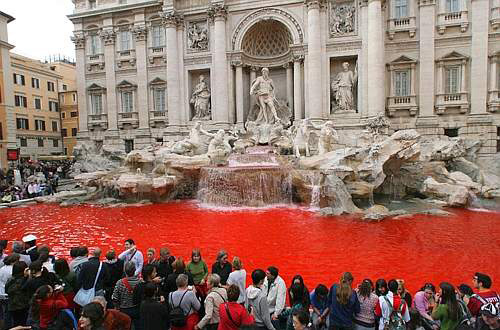
A group calling itself the ATM Azionefuturista 2007 has turned one of Rome's most famous monuments into a bloodied protest canvas.
One of its members, in full Futurist glee, “threw a bucket of red paint or dye into Rome's Trevi Fountain on Friday, coloring the waters of the 18th-century monument bright red in front of a crowd of astonished tourists and residents.”
The man escaped, leaving the fountain, which normally runs on a closed cycle, spouting red water. Police arrived and technicians briefly shut off the water before restoring a clear flow.
Experts said the baroque fountain was not permanently damaged and the marble statues depicting the sea deity Neptune on his chariot had not absorbed the color.
At first I thought the guy read an advance copy of The New York Times Magazine's extended report on the neverending water problems of the American Southwest, and so was compelled to carry out this guerrilla attack to highlight the impending climate change disaster to an audience of intensive carbon-producing tourists. Like a self-righteous Moses to a bunch of uber-consumerist Ramesseses.
But alas, based on leaflets found nearby, officials think that he was simply protesting against the “expenses incurred in organizing the Rome Film Festival.” The red waters of the Trevi, then, “symbolically referred to the event's red carpet.”
It was one simple gesture by one person, but the whole world has taken notice. So perhaps next year, another famous fountain will be made to spew vermillion waters — or preferably, made to stagnate and concoct a toxic stew of fluorescent green algae — to successfully call international attention to our present shared hydrological crisis.
Since the fountain is constantly being monitored by CCTV cameras, there is a video of the incident:

But here are some clearer photos, courtesy of Corriere della Serra:


The spirit of Umberto Boccioni still hovers over the heady waters of Italy.


