


|
|
|---|


Sunday, May 2, 2010

Thursday, September 3, 2009
Yesterday's photo of a roundabout cage wasn't exactly an Abbasidian aviary. It wasn't, as we fantasized, a leftover space re-landscaped into an urban ecological hotspot. As pointed out by a reader, it's the Quatre Pavés Water Tower (1971) by Pritzker Laureate Christian de Portzamparc.
In any case, it reminded us of an entry to the 2005 Chicago Prize competition, which sought fresh ideas on how to repurpose Chicago's ubiquitous water tanks.
Submitted by John Snavely, Sarah Dunbar and Stephen Perdue, it proposed converting these pointilist urban artifacts that still pockmark the city's skyline into a sort of neo-Olmstedian necklace of mini eco-parks for endangered migratory birds.
Chicago is an important stop along the Mississippi Flyway for many bird species during their yearly migrations. This contiguous, low-lying route unbroken by mountain ranges from the Arctic coast of Alaska south to Patagonia has been instrumental in developing migratory paths for various species. Adapting Chicago's water tanks for a new function is a unique opportunity to create a habitat that will enable an endangered bird to safely breed in the city. The Purple Martin, a large songbird who migrates south each year along the flyway has lost its entire natural habitat east of the Mississippi and nearly all of it west of the River. Martins are social birds who readily roost and breed in man-made houses. Given the loss of original habitats, Chicago can use existing infrastructure to connect to the flyway in such a way that birds better inhabit the city - making people aware of its critical relationship to the larger natural environment.
It's somewhat similar in concept to the second prize winner, but this one caught our greater attention because of its renderings of birds shooting out from the tanks, as though uncorked after many restless years in captivity.
For us at least, this image calls to mind any of the staple PBS nature documentaries showing millions of vampire bats whizzing out of their subterranean dwellings soon after the sun has dipped below the horizon. Across a fast darkening sky, darker clouds throb and shudder.
And it also reminds us of Richard Barnes' grotesquely marvelous photographs of European starlings “murmuring” in the skies over Rome.

Surely one must now be wondering whether these self-organizing bio-troposheres could be choreographed in the skies over Chicago.
Orphaned birds have been successfully taught forgotten ancient migration routes, even new ones, so why not imprint other behaviorally malleable birds to cultivate a sort of amorphous topiary sky garden. It would be like landscaping the ethology of an urban ecosystem.
With the ringing of a bell or some other trigger, the birds would surge out in torrents from their rookeries. With another ring (or perhaps guided by one or two oozological agents reared by Natalie Jeremijenko), they will then start to perform their aerial ballet, vacillating between chaotic noise and sensuous shapes, between turbulent instabilities and structured systems.
A living fog sculpting itself with its own meteorology. Reflecting the yellows and the ochres and the oranges at sunrise and sunset, the whole scene will surely look like a Turner painting.
Hack into Jeremijenko's ooz-birds and you can control the flock. Direct an avant-garde staging of The Birds or Mary Poppins if you want. Or do a little bit of guerrilla sky gardening.


With the rising popularity of urban farm animals, perhaps these chickens and honeybees and miniature cows and even the city's existing menagerie of sewer rats and flying rats (and let's not forget the cats and dogs of gentrified inner neighborhoods) can be conscripted and turned into trained acrobats.
Or are they all together already performing one unending gigantic urban show for us humans?
Wednesday, July 15, 2009

This is a postscript to our post on the sewer zeppelins and artificial lakes of Rome.
Every weekend during the sweltering month of August, from 1652 until 1866, the drains of the Fontana dei Quattro Fiumi were blocked so that the waters would overflow and flood much of Piazza Navona, a sort of aqueous reincarnation of the naumachiae, or mock naval battles, that were once staged on the same site more than a thousand years ago. Or perhaps this aberrant hydrology was an attempt to mimic the floodplains of the real Quattro Fiumi. It could even be described as the temporary, theatrical reemergence of the marshy landscape on which the Eternal City was built.
In any case, it was one of the most popular midsummer festivals in Rome, the “merriest of them all,” according to the poet Henry Wadsworth Longfellow. Members of the nobility and gentry came in droves in their carriages. Watched by gazers crowding the shores of this artificial lake or looking out from the windows of the palaces surrounding the piazza, princes and nobles would parade side by side with peasants and farmers around and around the water's shallow periphery or crisscross across deeper parts. It probably didn't take long until the water became just a dirty puddle, but one could still churn up microgusts of cooling breezes. On the dry portions of the piazza, entertainments were set up, as well as booths for refreshments.
This urban hydro-spectacle would go on all day, until sunset, sometimes even into the night. Then the piazza was drained, and the water once again contained in its Baroque basin.
As a postscript to this postscript, check out Millennium Park's Crown Fountain, whose seasonal artificial lake swarms with hyperactive, overheated, giggle-infected kids (and adults) every summer.
Once a year, after a multi-million dollar renovation, the twin spouts of Crown Fountain will be allowed to gush out as though they were gigantic fire hoses, flooding the entire park. Frank Gehry's sunken pavilion becomes an inland sea in which concert goers ply the waters on gondolas. The Lurie Gardens transform into a wetland prairie. Anish Kapoor turns into an island. The new Nichols Bridgeway is repurposed as a water slide. And everywhere waterfalls cascade down Neoclassical stairs.
That or truck in a few dumpster pools as counter-pavilions to the two pavilions commissioned for the anniversary celebrations of Daniel Burnham's Plan of Chicago.
Thursday, July 2, 2009

Last month, a cadre of guerilla architecture critics (or just plain vandals) splashed the white walls of Richard Meier's Ara Pacis Museum with green and red paint, thus rendering the Italian tricolor in an unintentional homage to America's greatest living painter, though permanent Roman habitué, Cy Twombly.
It was presumably the first outwardly visceral manifestation of popular distaste for the building.
Many others no doubt would like nothing more than to deface the museum. The mayor, for instance, has been very vocal about wanting to remove it (minus the altar, of course) and then reconstruct it fuori le Mura. Whether this would mean that the original will be recycled for the new building or entirely torn down into unsalvageable detritus, these urbicidal fantasies of demolition, alteration and displacement are pretty much on par with the spatial history of the piazza.
The new building, for instance, replaced a pavilion partly designed by Vittorio Ballio Morpurgo under Benito Mussolini to house the Ara Pacis, which was discovered somewhere offsite and relocated to its present location. This earlier building was dismantled, because it was deemed incapable of protecting the ancient monument from Rome's damaging pollution and summer weather. However, a stone wall containing inscriptions of the Res Gestae Divi Augusti was saved from total annihilation and incorporated into Meier's building design. A new temple built on top of the foundations of an old temple.
Meanwhile, the demolished pavilion itself was part of a Fascist program of erasure. Mussolini wanted to create a new piazza, the center piece of which would be the Mausoleum of Augustus. At the time, parts of the tomb laid buried beneath several layers of urban fill and topped with a concert hall, the latest in a long line of adaptive reuse programs. The tomb was further “hidden” by narrow streets and dense urban growth. To “liberate” it, Mussolini simply obliterated the surrounding neighborhood.
Left untouched were a couple of churches, one of which, San Rocco, is a fascinating impasto of Renaissance, Baroque, Neo-Classical and Palladian styles. These survivors — together with Morpurgo's pavilion and a complex of new modern buildings for use by Fascist Party functionaries — were calibrated to frame the bounded space of the new Piazza Augusto Imperatore.
It's interesting to note here that embedded on the facades of the new buildings are friezes, mosaics and inscriptions, a decorative program no doubt intended to create a link with the sculptural reliefs on the Ara Pacis on the other side of the piazza. One of those inscriptions, apart from mythologizing Mussolini and Fascism, actually commemorates the restoration of the Mausoleum of Augustus and by extension celebrates the urban pogrom that had to be metted out in order to “liberate” the tomb from its shadowy grave. So perhaps if the mayor were to carry out his own pogrom, then he, too, may commemorate it with yet another set of friezes on the front of his new museum. And obviously these new friezes will also memorialize our liberation from starchitectural stupor.
In any case, to add to these violent, cross-spatiotemporal architectural critiques, Meier stated after the demolition of Morpurgo's pavilion but before the start of construction of his new museum that he wanted (and may yet still want) to tear down the other Fascist-era additions to the piazza. These buildings may have perfectly acted out Mussolini's urban scenography of Fascist ideologies but the resulting piazza is an incredibly failed urban space. It's inhospitable to everyday use and pedestrians avoid it. Meier presumably knows better. And if he gets his way, then there would be another occasion for textual frotteurism and iconographical link-orgy: a sculptural band of friezes in which we see the wannabe urban planner in the guise of the Angel of Modernism — Meier Dux, the liberator of the Eternal City from its own ancientness.
But we're obviously digressing.
When reading about the incident, what grabbed our complete attention wasn't the paint job. What actually spurred us into confecting this post was the porcelain toilet and the two packs of toilet paper left at the scene.
Because these scatological implements aren't the most imaginative form of “activism” (or for no other reason than just because), we set about concocting less facile, though dubiously practical, strategies of protest. We used the following as points of departure.
1) As far as we know, no one has yet come forward to claim responsibility for the vandalism. The presence of Graziano Cecchini in the crowd of onlookers at the scene, however, elicited some very faint accusatory speculations. Cecchini, you might remember, was the artist and member of the neo-Futurist group, ATM Azionefuturista 2007, who dyed the Trevi Fountain red nearly two years ago, an incident which we covered here then. If you can also recall, he turned the fountain's crystal clear waters into a vermillion Nile as a way to protest the obscenely high cost of organizing that year's International Film Festival of Rome — like a self-righteous Moses preaching to a bunch of uber-consumerist Ramesseses.
2) Earlier that summer, another incident occurred at the Trevi Fountain and at other Roman fountains. You can say that it was similarly faintly Biblical: the waters parted — or rather dried up — which is probably the same thing. The culprits that time weren't hydro-anarchists venting out grievances with the hegemonic elite. Vandal-artists weren't enacting one of their staged happenings using the built environment as their canvas and minor urban disasters as their paint. As we reported at the end of last year, the water supply to the fountains was cut short when construction workers across town damaged an ancient pipe while building a private underground car park. The blockage was discovered when a waterborne camera was slithered through the city's rhyzomatic ecosystem of voids to pinpoint its location.
While the tired, sweaty tourists around the city didn't erupt into a riotous mob, this incident left us wondering whether they could be agitated into a pillaging horde, ransacking archaeological sites and museums, by strategically pinching the right combination of ganglial pathways of the city's infrastructural network.
3) Staying in Rome but venturing more than a century back in time: in the 1870s, we read in The Colosseum by Keith Hopkins and Mary Beard, archaeologists dug up the floor of the Colosseum and exposed its basement corridors. This apparently upset so many people, including the Pope, because it meant removing the arena's religious paraphernalia, such as the Stations of the Cross, a huge crucifix in the center and a hermitage and its hermit. The recently unified Italian state, in other words, was seen to be trampling over sacred ground, and the birthplace of so many martyrs and saints, was to be converted into a secular artifact, an archaeologist's play pen.
But of greater interest for us here is the fact that during the excavation, drainage was such a problem that the sewers and underground corridors had filled with water. Harkening back to when it used to host mock naval battles, the Colosseum remained an artificial lake for many years until a new sewer was built to channel the water away.
4) Returning to the present but now venturing out of the city: decorating this post are CC-licensed photos of Stuck Inflatable Zeppelin, one of several installations collectively called Sciame di Dirigibili by the Mexican artist Héctor Zamora at this year's Venice Art Biennale.
5) Further afield: in an article published by The New York Times in 2003, we learned that public works officials in New York sent a self-propelled, submersible Autonomous Underwater Vehicle (AUV) down into in the 85-mile long Delaware Aqueduct that supplies New York City with half of its drinking water. Millions of gallons have been leaking, and they wanted to know where and how it was seeping out.
Leakage of up to 36 million gallons a day was detected starting in 1991. The leaking stretch lies somewhere between the Rondout Reservoir in the Catskills and the West Branch Reservoir, a way station for city-bound water here in Putnam County.
The escaping water is just a small percentage of the 1.3 billion gallons supplied by the system each day, but still equals the daily consumption in Rochester.
Water percolating upward hundreds of feet from tunnel leaks has created wetlands and damp areas in Ulster and Orange counties that endure even in the region's worst droughts.
The city's engineers have been periodically sending, as recently as last month, torpedo-shaped, deep-sea robots to monitor the cracks.
There are important lessons about crumbling infrastructure and the importance of surveillance and maintenance in an age of peak water and climate change that no doubt could be extracted from here, but we have to move on.

So. Instead of leaving cute trinkets next to one's object of disgust, you go for the jugular.
First assemble together a fleet of self-propelled, subterranean dirigible. Be sure that they can navigate through both water-filled tunnels and more airier ones. To be able to track their location and velocity, implant each one with an iPhone or any cheap, GPS-enabled mobile device.
With maps of the negative labyrinth on hand, you let them loose. At designated strategic nodes, you phone them. They pause in mid-flight. Seconds later, they inflate and wedge themselves very tightly in the tunnel. If the tunnel is too big, then several of your dirigibles will clump together to ensure total blockage. And then finally, using the sewers' miasmic vapour as a reagent, their nylon skins fantamagically fuse with the tunnel walls and turn metallic, nearly diamond-hard. An hour or two later, manholes and storm drains begin venting your furious critique. A further hour or two, an artificial lake lays stagnant next to (or better yet, surrounds) the target building.
Of course, the target needn't be a building. It could be a new plaza as anti-pedestrian as the Piazza Augusto Imperatore. Or an obscenely overbudget hyper-park. Or a grotesquely earnest memorial. Or a similarly ghastly public art installation whose aesthetics suggest it has time-travelled from the 80s. Whatever it is, you consider it a pestilential addition to the built environment in the same way your artificial lake is a deadly public health hazard.
Not surprisingly, others with their own beef and their own agenda will copy your tactics. Sewers all over the world will be swarming with dirigibles, buzzing with the amplified hum of their tiny propellers. Artificial lakes will bubble up and vanish, rising and falling in accordance to the perennially shifting climate of architectural taste.
Not surprisingly as well, officials will try to stop these acts of sabotage. They will take sewer maps out of the public domain. They will even request the federal government to classify them as state secrets. Consequently, all public works employees will have to undergo extensive background checks and sign non-disclosure agreements. Urban adventurers will be charged with espionage if found hiking through the tunnels. Or simply shot on site as they claw their out of the sewers like Harry Lime in The Third Man.
If the public before were oblivious to the vast underground landscape that makes their life possible, only getting a hint of what lies beneath when an underpass is flooded or when a boy mysteriously goes missing while out exploring an abandoned section, then they will now be utterly, completely, permanently ignorant.
When a boy does indeed go missing, there will be no search and rescue and thus no wall-to-wall television coverage of melodrama. There will be no prolonged national hysteria over the fate of the child, and there definitely will be no photogenic heros confected out of the whims of the masses. The missing kid will simply be censored from the day's news, and the parents will be told they never had that child.
The kid, like the sewer maps, will be redacted.
In response, sewer anarchists will outfit their dirigibles with DIY sonars or laser scanners. They will make their own maps.
As a counter-countermeasure, combat engineers will reconfigure the network into an even more bewildering jumble of tunnels. They will dug fake tunnels, tunnel that leads to dead ends, tunnels that impossibly knot into themselves, tunnels with sonar-cancelling pings, tunnels that lead to police headquarters, tunnels that effloresce into a thicket of infinitely bifurcating tunnels, and tunnels that lead to other dimensions.
Alternatively, they will de-tangle the network. Obsolete tunnels will be filled in, others consolidated. Certain segments will be expanded into rationally planned, naturally lighted, cathedral-like vaults. These tunnels will actually be more than what the city needs to funnel its wastewater and stormwater, but at least they will be hard to be barricaded. It's the Haussmannisation of the sewers.
The other side, of course, will simply hack their dirigibles into more sophisticated mapping tools and employ advanced computer modeling techniques to simulate alternative infiltration strategies.
It's one side always trying to outwit the other side.
Because whoever rules the sewers rules the city.
Sunday, May 3, 2009

For the past 3 years, a team of archaeologists, architects and computer scientists have been laserscanning the underground network of burial chambers, tunnels and chapels carved out of the soft, volcanic tufa rock of Lazio.
The scanner, according to BBC News, “looks like a cylinder on a tripod, stands a metre or so high and is a piece of kit you usually find in the construction industry.”
Gone are the days when archaeologists just used shovels, brushes and sieves to unearth the past.
The scanner has been placed in hundreds of different locations in the Catacombs.
It turns slowly, sending out millions of light pulses that bounce off every surface they come into contact with. The light pulses rebound back into the scanner and are recorded on a computer as a series of white dots, known as a "point cloud".
Gradually, every wall, ceiling, and floor is bombarded with the dots, enabling the computer to build up a picture of each room.
All told, “four billion dots” were gathered, and on a computer screen, they coalesce into a digital 3D model of the necropolis: a filigreed network of subterranean voids that's not unlike the complex clustering of a Romanesque basilica and its companion buildings.

You can zoom in and zoom out, rotate about the axis, and render it with color. Perhaps you can record your scopic drive through this digitized world, as one would with Google Earth. Give it a soundtrack, and you've got yourself a YouTube music video.
And maybe Radiohead would like to give it a go for a sequel to House of Cards.

One of the stated goals of the project is to study the paintings in the Domitilla catacombs: from the pagan images of the early 3rd century to the theologically fully developed Christian iconography of the late 4th century, and how this micro-history of early Christian art reflected the broader changes in late Roman society.

Now if only someone could make the laserscanner mobile (a spelunking Paranoid Android) and then send it roving through other labyrinths — other necropolises, ancient underground aqueducts, sewers, stormwater megatunnels, abandoned subway tunnels — kicking up an underground maelstrom of point clouds.
Google comes a-knockin', and soon everyone will be exploring these passages in a flurry of nighttime clicks. Google Hadesview®.
Rome Stillborn 1.0
Tuesday, December 23, 2008

While writing our earlier post on Rome, we remembered that the city is pockmarked with stone markers accurately recording the dates and high water marks of historic flood events. Most are embedded on the sides of buildings, and their inscriptions read something like this:
ANNO DOMINI MCDXXII IN DIE SANCTI ANDREE CREVIT AQUA TIBERIS USQUE AD SUMITATEM ISTIUS LAPIDIS TEMPORE DOMINI MARTINI PAPE V ANNO VI.
Or:
In the year of the Lord 1422 on the day of Saint Andrew the water of the Tiber rose as far as to top of this stone, in the time of Pope Martin V, his sixth year.
In many markers, a finger, from which a swirl of lovely, frothy curlicues swooshes out, points instead to the upper limit of inundation.
According to Aquae Urbis Romae, “nearly one hundred flood markers still exist,” with the earliest dating to the 13th century. None from earlier eras are extant, but presumably there were many, a collective testament to a watery past.
When it wasn't being ravaged by veritable dry disasters such as barbarian invasions, plagues and fires, Rome drowned.
Monday, December 22, 2008

Something about the Tiber River nearly breaching its banks and nearly submerging Rome in torrents and mud earlier this month reminded us of an antipode event last year. It's one of our favorite stories that entire year.
As reported by Reuters, “water supplying Rome's world-famous Trevi Fountain was cut off when a builder across town damaged a 2,000-year-old pipe.” Luckily enough for the carabinieri who might have had a riotous mob of tired, sweat-drenched tourists on their hands, the fountain didn't dry out; it simply recycled the water already in its basin. Unfortunately, “many smaller Rome fountains spluttered to a halt.” Equally unfortunate, we didn't hear too much of pissed-off Germans and English hydro-hooligans ransacking museums and pillaging nearby archaeological sites.
But what could have caused these minor urban disasters?
A search using a waterborne video camera through the ancient pipe tracked the blockage to a house in the high-end Parioli neighborhood on the other side of the Villa Borghese park, where builders were making a private underground car park.
A spokesman for the [local] water company said the builder had broken the pipe, then tried to mend it with concrete, but instead had filled it in.
Interconnected narratives of spaces, infrastructures, people, histories — all of that — all incredibly fascinating.
But we weren't satisfied with how the story ended (the water was temporarily diverted to a “younger pipe” while repairs were being done): so let's concoct some plot points for the pilot episode of, say, CSI: Rome. Let's imagine that a body has been encased in that concrete.
To solve this murder case, an obscenely photogenic forensic cartographer must map out the Eternal City's subterranean trash heap of functioning and disused aqueducts. Is it a simple mafia hit or is it something more deliciously sinister, a more expansive, twist-n-turny mystery that can be story arced through an entire season, even the whole run of the series?
“Follow the flow,” orders his supervisor.
However, he soon realizes that the technology at his disposable can't possibly do such a complex task. He calls 811, but no one answers, and it's not even lunch time. “So Italian,” he grumbles, in Italian.
Desperate, he makes a call to the Italian subsidiary of some leading global research company to see if they can supply him with advance technology. He knows that it'll be tit-for-tat, that at an unannounced later date, they will call in their favor and he will have to oblige them unconditionally, he is still willing to go into a bargain. Primetime televisual exposition requires that the company immediately procures for him exactly the right tools for the job: he is given a batch of RFID-tagged robo-spiders and dedicated access to their private fleet of spy satellites.
The mapping begins. Large sets of numbers are uploaded, downloaded and then crunched by supercomputers. Slowly, Rome's negative voids get digitally unearthed.
So begin as well those disembodied whispers, furtive glances from strangers in the streets, vague feelings that the contents of his office desk have been messed about. Up in those gilded residences of Parioli, a curtain parts slightly each time he comes by to conduct his investigation. There are forces working to derail him, but there are also others who want his map completed. But why?
During one espresso-filled night, he gets his first major break in the case: from out of that rhizomatic mess of ancient and modern hydro-infrastructure, a pattern emerges...
Ensanguining the Trevi
Sunday, October 21, 2007
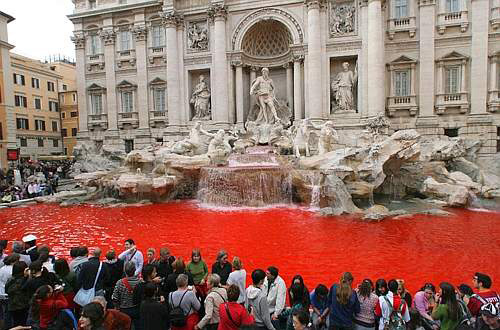
A group calling itself the ATM Azionefuturista 2007 has turned one of Rome's most famous monuments into a bloodied protest canvas.
One of its members, in full Futurist glee, “threw a bucket of red paint or dye into Rome's Trevi Fountain on Friday, coloring the waters of the 18th-century monument bright red in front of a crowd of astonished tourists and residents.”
The man escaped, leaving the fountain, which normally runs on a closed cycle, spouting red water. Police arrived and technicians briefly shut off the water before restoring a clear flow.
Experts said the baroque fountain was not permanently damaged and the marble statues depicting the sea deity Neptune on his chariot had not absorbed the color.
At first I thought the guy read an advance copy of The New York Times Magazine's extended report on the neverending water problems of the American Southwest, and so was compelled to carry out this guerrilla attack to highlight the impending climate change disaster to an audience of intensive carbon-producing tourists. Like a self-righteous Moses to a bunch of uber-consumerist Ramesseses.
But alas, based on leaflets found nearby, officials think that he was simply protesting against the “expenses incurred in organizing the Rome Film Festival.” The red waters of the Trevi, then, “symbolically referred to the event's red carpet.”
It was one simple gesture by one person, but the whole world has taken notice. So perhaps next year, another famous fountain will be made to spew vermillion waters — or preferably, made to stagnate and concoct a toxic stew of fluorescent green algae — to successfully call international attention to our present shared hydrological crisis.
Since the fountain is constantly being monitored by CCTV cameras, there is a video of the incident:

But here are some clearer photos, courtesy of Corriere della Serra:


The spirit of Umberto Boccioni still hovers over the heady waters of Italy.


