


|
|
|---|


Saturday, May 10, 2008
Round 3 of the 2008 SUPER GT took place on May 4th (Sunday) at Fuji Speedway (1 lap: 4.563kms), located in Oyama town, Shizuoka prefecture. All five NISSAN GT-R entries were saddled with added weight for the race in the form of a “Special Performance Adjustment”. The #12 CALSONIC IMPUL GT-R was the top qualifier in 10th, the car completing the race in 9th place.

The race, occurring in the middle of the Golden Week holidays, attracted 56,900 race fans to Fuji Speedway in warm but overcast and breezy conditions, the 500-kilometre event getting underway at 14:00. The NISSAN GT-R entries, after scoring consecutive 1-2 finishes in the first two rounds of the season, all finished down the order in qualifying after the imposition of the “Special Performance Adjustment”.
The lightest among the GT-Rs, the #24 KONDO Racing machine of Joao Paolo de Oliveira and Seiji Ara started 12th, but by the end of the opening lap had jumped to ninth. Starting driver Oliveira ran consistently, moving up one more position to eighth on lap 22. After all entries had made their routine pit stops and driver changes, the order settled down again on lap 40, and the car was running ninth. Seiji Ara continued the consistent pace, but on lap 66 a tyre blew, necessitating an unscheduled return to the pits and lost time. He went back out on track, but was unable to claw back the positions and ended the day 11th.
The #12 CALSONIC IMPUL GT-R (Tsugio Matsuda/Sebastien Philippe) started the day in 10th, but fell to 13th in the opening laps. Shortly after, a racing accident with the #22 GT-R caused the car to fall to 15th. The machine would rise as high as 7th in the latter stages but spun on its own on lap 81, settling into 10th and eventually finishing 9th.
Meanwhile the #3 YellowHat Tomica Moba Ho! GT-R suffered from mechanical problems, ending the race is the same position it started, 15th.
Neither of the two NISMO entries was able to reach the heights of the two previous races. NISSAN’s ace car, the #23 XANAVI NISMO GT-R (Satoshi Motoyama/Benoit Treluyer), was imposed the heaviest success ballast yet for its two consecutive wins. This, plus the Special Performance Adjustment, meant the car couldn’t show its previous prowess, and started 13th.
Every lap, the #23 machine was two seconds slower than the top cars, and though they saved their tyres and fuel with a one-stop strategy, the gap to the front was so big they were unable to improve their pace, finishing the day 14th.
Their teammates in the #22 MOTUL AUTECH GT-R (Michael Krumm/Masataka Yanagida) started 16th. The conditions in the car were favourable, and they were expected to move up in the early stages. However, a few problems, including making contact with the #12 car, the careless mistake by Yanagida resulting in a 10-second Stop and Go penalty, saw Krumm finish 10th – a points-scoring position. Unfortunately, on the last lap he made contact with another car while fighting for position, receiving a 35-second penalty, demoting the car to 12th.
Team Director Yoshitaka Iijima’s comments after the race:
“It was an unfortunate result today. The #22 car was beset with misfortune and mistakes, but ran well. Therefore I regret that the drivers received three penalties. As for the #23 machine, it was just too heavy with the Special Performance Adjustment. We simply weren’t able to show the performance of the car all weekend. In SUPER GT, the regulations don’t allow a winner to keep on winning. Also, this time the Special Performance Adjustment was heavier than expected. However, from here the situation changes. We’ll reflect on this ahead of the next round at Sepang where we’ll be doing our level best for all of our fans.”
see on automotive news for [Race Results] 110Laps
Friday, May 9, 2008
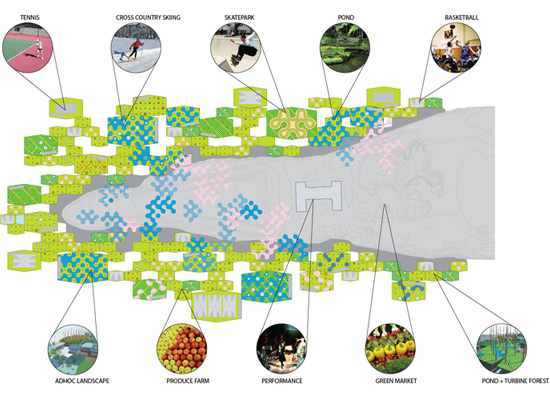
When we were fantasizing about Venice as a reconfigurable jigsaw puzzle, we had in mind, among other things, PARA's submission for an ideas competition to “rejuvenate” the “ruins” of New York City's Roosevelt Island.
Called Mobile Art Park, it's a cultural and sports complex conceived as a “network of floating barges.”
The barges form a migrating network that extends throughout the regional waters of New York’s five boroughs and beyond. Linking together in multiple combinations, the barges accommodate different events at the scale of the entire Southpoint site. Dispersed throughout the city, the barges bridge culturally disparate enclaves with the vibrant communities of artists already thriving in the city.
Each barge, then, could hold a tennis court, a skatepark, a farm and a farmer's market, a forest or a combination thereof. There are wind turbines as well.


Having been reminded recently of MVRDV's Dutch Pavilion languishing in the now shuttered grounds of Expo 2000 in Hannover and also the ruins of Expo 1992 in Sevilla, we propose that in a future universal exposition, all buildings should rest atop floating platforms. Or are actually the floating platforms themselves. Each one would be built by the participating nations in their own ports, anchored there until the start of the expo nears and the armada needs to be assembled.
In this world's fair, the overall theme could be future coastlines, perhaps established by Adriaan Geuze of West 8. He is hired as creative director, because he once curated The Flood.
In his program brief, he will call attention to the fact that “around the world cities are situated on low-lying coastal zones and in delta regions where rivers enter the sea. These are amongst the most fertile areas and are well linked by sea and land to the world. But these are also cities with populations in the millions that are now highly vulnerable because of the threat of flooding.”
Of course, Adriaan Geuze will have plenty of solutions to combat this threat to showcase at the host city, New Orleans.
Or it could be the first ever major international event to be held on international waters, just offshore from Burma's Irrawaddy Delta with a satellite venue a few miles from Bangladesh's Ganges-Brahmaputra Delta.
As its national pavilion, the U.S. will send the supercarrier USS Nimitz, which accidentally rams into Zaha Hadid's pavilion. Tant pis.
When the expo ends, each pavilion will return to their home port, becoming art centers or public open spaces or artificial reefs.
Floating Pool

Speaking of Venice, there were some reports a couple months ago telling us that officials are “pursuing [a] proposal with great interest” that could save the city from sea level rise.
According to Agence France-Presse, “Local officials and engineers are planning to lift buildings under operation 'Rialto' by up to one metre (3.3 feet) using piston-supported-poles to be placed at the bottom of each structure. This will take around a month per building if each structure is raised by eight centimetres (3.14 inches) a day.”


There is another project, one that is actually being realized, to save Venice. Called the MOSE Project, it involves constructing adjustable barriers at the three entrances to the Venetian Lagoon. While these barriers may protect the city from future floods, buildings whose lower levels are already submerged will remain inundated, continuing to rot at their foundations. In other words, there is really no change in the status quo.
Project Rialto, on the other hand, will restore access and functionality to once flooded floors. There is also the possibility of lifting the building still higher if needed, for instance, if sea level rise exceeds the design parameters of the barriers and overtops them. Meanwhile, the city and its neighborhoods may begin to resemble what they were like before things started sinking.
Of course, we have to wonder why would you want to revive an image of its past? It won't reverse the exodus of its citizens or prevent it from becoming an open air museum.
Why not use this opportunity to play around with the built environment? You could, for instance, jack up this palazzo up higher than 3.3 feet. Or that palazzo by a towering 50 feet.
Sculpting negative spaces, reconfiguring campi, creating a second piazza.
Better yet, you slip in a barge under them. Venice as a tectonic jigsaw puzzle, its mini-island pieces floating but firmly tethered for most of the time until the curator of a future edition of the Architecture Biennale wants to rearrange things.
Or until the Art Institute of Chicago decides to organize a blockbuster exhibition on Venetian palazzos or Tate Britain on Turner's Venice. When their entreaties for loans are answered, chunks of the city will unmoor themselves from the lagoon. Once equipped to ward off Somalian pirates, they will simply sail away, leaving behind some scaffolding wrapped with full-scale photographic replicas of the borrowed architecture to let disappointed tourists know what they are sorely missing.
Galveston on Stilts
Thursday, May 8, 2008

This is lovely. It's London re-imagined in 1899 as La Serenissima-upon-Thames. Go see.
Of course, when London gets flooded for real by the middle of this century, the city will not look quite as charming. No Lonely Planet devotee would want to go there during his gap year. Instead, it would most certainly become a pestilential swamp, ridden with malaria and mutagenic superviruses, a methanous bog slowly digesting St. Paul's. 
And behind every crumbling facade, a coven of sub-humans patiently waits for the night when they can continue their hunt for Will Smith.
Wednesday, May 7, 2008

The most powerful Volkswagen Passat ever produced is now on sale.
The new Passat R36, available in either saloon or estate bodystyles, is equipped with a naturally-aspirated 3.6-litre V6 engine developing 300 PS and 258 lbs ft of torque. Drive is channelled via a six-speed DSG gearbox through a 4MOTION all-wheel drive system capable of diverting torque to either axle depending on the grip available. As a result the saloon is capable of accelerating from rest to 62 mph in 5.6 seconds while the estate takes 5.8 seconds. Both models have limiters in place to restrict the top speed to 155 mph.
A set of 18-inch wheels housing Volkswagen 'R' blue brake callipers and a ride height lowered by 20 mm help distinguish the Passat R36 from the conventional vehicle. A new front bumper featuring a trio of deep airdams is joined by the distinctive chrome grille section inset into which is the 'R36 badge'. A set of Bi-Xenon headlight units complete the changes. At the rear a set of twin tailpipes, routed to either side of the bumper, compliment a subtle lip spoiler. The only badging comprises a simple 'R36' logo and the Volkswagen roundel.
The changes continue to the vehicle's interior. Unique front seats designed to offer greater lateral support are placed behind a sculpted sports steering wheel integrated into which are paddles for the DSG gearbox. A set of recalibrated 'R' dials are fitted alongside turned aluminium dashboard highlights, alloy pedals and sill plates bearing the 'R' logo.
Prices for new Passat R36 start at £30,990 on-the-road for the saloon and £32,150 for the estate model. Options include a choice of four colours ranging from silver to black, blue and grey. A further option of 19-inch wheels will also be offered at a later date.
As with the Golf R32 and Touareg R50 the Passat R36 was designed, engineered and developed by Volkswagen Individual. Established in 2003 and based in Wolfsburg, Individual is assigned with producing bespoke and highly focused vehicles such as the 'R' line-up as well as the BlueMotion range. The Passat R36 represents the fastest accelerating vehicle currently produced by Individual and Volkswagen.

Audi has facelifted the A3 and while the tweaks can at best be described as mild, a new S3 Sportback has joined the line-up. The hot five-door runs the same 261bhp 2.0-litre TFSI engine found in the three-door S3, and of course the quattro four-wheel drive system is standard.
The exterior cosmetic surgery brings the looks of the A3 Cabriolet to the rest of the range. Tweaks include new headlights with standard daytime running lights and a new grille. The optional bi-xenons feature LEDs while the rear end of the A3 also gets new tail lights and a revised rear bumper that lengthens the car.
What about proper engineering tweaks for the facelifted Audi A3 and S3?
The VW Group’s new seven-speed twin-clutch gearbox will be available with the 1.6, 1.4 TSFI and 1.8 TFSI engines, while others engines will have the option of the six-speed S-tronic box. The semi-auto system is standard on the 3.2 quattro. Audi’s magnetic ride system also becomes an option on higher-end models, while tweaks to petrol engines cut consumption by as much as 15 percent.
Audi was the first premium manufacturer to offer a small hatch back way back in 1996, and the changes to the A3 should keep it fresh while Ingolstadt launches a whole raft of niche products over the next few years.
Tuesday, May 6, 2008

Body
• Two-door coupe body style with 2+0 seating
• Bonded aluminium VH structure
• Aluminium, magnesium alloy and carbon-fibre composite body
• Extruded aluminium door side-impact beams
• High Intensity Discharge (HID) headlamps (main beam)
• LED rear lamps and side repeaters
Engine
• All-alloy, quad overhead camshaft, 48-valve, 5935cc V12
• Compression ratio 10.9:1
• Front-mid mounted engine, rear-wheel drive
• Fully catalysed stainless steel exhaust system with active bypass valves
• Max power: 380kW (510bhp/517 PS) at 6500rpm
• Max torque: 570Nm (420 lb.ft) at 5750rpm
• Acceleration: 0-100km/h (0-62mph) in 4.3 seconds
• Max speed: 302km/h (191mph)
Transmission
• Rear-mid mounted, six-speed manual gearbox
• Alloy torque tube with carbon fibre propeller shaft
• Limited-slip differential
• Final-drive ratio 3.71:1
Wheels and Tyres
• Front: 8.5’’ x 20’’ Pirelli P Zero 245/35
• Rear: 11’’ x 20’’ Pirelli P Zero 295/30
Steering
• Rack and pinion, Servotronic speed-sensitive power-assisted steering, 3.0 turns lock-to-lock. Column tilt and reach adjustment
Suspension
• Front: Independent double wishbone incorporating anti-dive geometry, coil springs, anti-roll bare and monotube adaptive dampers
• Rear: Independent double wishbones with anti-squat and anti-lift geometry, coil springs, anti-roll bar and monotube adaptive dampers
• Adaptive Damping System (ADS) with Track mode
Brakes
• Front: Ventilated carbon ceramic discs, 398mm diameter with six-piston callipers
• Rear: Ventilated carbon ceramic discs, 360mm diameter with four-piston callipers
• Dynamic Stability Control (DSC) with Track mode
• Anti-lock Braking System (ABS)
• Electronic Brakeforce Distribution (EBD)
• Emergency Brake Assist (EBA)
• Traction control
Dimensions
Length: 4721mm (185.9’’)
Width: 1905mm (75’’) (exc. Mirrors)
2060mm (81.1’’) (inc. Mirrors)
Height: 1280mm (50.4’’)
Wheelbase: 2740mm (107.9’’)
Fuel tank capacity: 78 litres (17.2 Imp.galls, 20.5 US galls)
Weight: 1695kg (3737lb)
Interior
Semi-aniline leather and Alcantara interior. Matrix alloy facia trim and Iridium Silver centre console finish. Carbon fibre door trims and door pulls. Auto-dimming rear-view mirror & garage door opener (USA & Canada only). Sports seats with ten-way electric adjustment, including height, tilt and lumbar. Memory seats & exterior mirrors (three positions). Dual-stage driver/passenger front airbags. Side airbags (Sports seats only). Heated seats (Sports seats only). Heated rear screen. Automatic temperature control. Organic Electroluminescent (OEL) displays. Trip computer. Cruise control. Hard Disk Drive (HDD) satellite navigation system1,2. Bluetooth telephone preparation1. Powerfold exterior mirrors. Front and rear parking sensors. Tyre-pressure monitoring1. Alarm and immobiliser. Remote-control central door locking and boot release. Battery disconnect switch. Battery conditioner. Tracking device (UK only). Boot-mounted umbrella.

In-Car Entertainment
• Aston Martin 700W Premium Audio System with Dolby® Pro Logic II®
• MP3 player connectivity
Options
• Lightweight seats with six-way adjustment, including front and rear height adjust (Does not include side airbags or heated seats feature. Not available in USA or Canada)
• 20’’ alloy wheels with graphite finish
• Satellite radio system (USA only)
• Piano Black facia trim and centre console finish
• Leather storage saddle
• Personalised sill plaques
• Auto-dimming interior rear-view mirror1
• Auto-dimming interior rear-view mirror with garage door opener (Europe only)
• Alarm upgrade (volumetric and tilt sensor)
• Tracking device3
• First-aid kit
• Ashtray and cigar lighter

Spotted yesterday on Der Spiegel is the above photograph of tulip farms in the northern Netherlands. No doubt artificially induced to coincide with Mother's Day in the U.S. and in many other countries this month, we see the fields explode in Suprematist technicolor.
It's Nature turned into a machine, detached from the natural cycles of time and geography — in other words, detached from itself — re-landscaped here to service a $40 billion global flower industry.
Once harvested the flowers will embark on a whirlwind journey. They will pass through greenhouses, cutting rooms, auction houses and conveyor belts — in fact, through a massive industrial complex not unlike the gargantuan automobile assembly plants of the Big Three — before then being loaded on to trucks and cargo planes, enlarging their carbon footprint en route to points elsewhere, where they may be placed in quarantine spaces by customs officials with other flowers similarly displaced from other growing regions till they are finally allowed to continue on to neighborhood flower shops and awaiting mothers.
Unnaturally but beautifully assembled bouquets as mobile landscapes.
Salt Ponds
Saturday, May 3, 2008

Hamilton, Ontario – A new research institute has been established at McMaster University in Hamilton, Ontario to coordinate its increasing involvement in the automotive sector. The McMaster Institute for Automotive Research and Technology, or MacAUTO, brings together more than 75 researchers in engineering, science, business and other faculties involved in automotive-related research, and involves collaboration with more than 30 private and public sector organizations.
“Better coordinating our efforts across disciplines will lead to new ideas and better solutions for the automotive industry,” said Mo Elbestawi, vice-president of research and international affairs at McMaster. “It will also make it easier for organizations to access our pool of highly-qualified researchers and leading-edge facilities to advance a vital industry sector in Ontario and worldwide.”
Recent initiatives have added the General Motors of Canada Centre for Automotive Materials and Corrosion, the joint Initiative for Automotive Manufacturing Innovation with the University of Waterloo, and the General Motors of Canada Centre for Engineering Design.
“We are positioned to make significant contributions to the next generation of automobiles and how they impact society,” said David Wilkinson, dean of the Faculty of Engineering at McMaster. “We are also developing the expertise that will move these advancements forward in the future.”
read this autonews from the source


