


|
|
|---|


Sunday, March 27, 2011

Perhaps just for a moment today, completely forget all your worries on the datum and go climb a tree, for today is International Tree Climbing Day!
You flâneurs, drifters and urban explorers in your subterranean playgrounds, “liberate the horizontal and integrate the vertical super-surface.”
You ramblers, hikers and vagabonds, forget those Norwegian show-offs and make your own DIY pop-up lookout platform.
Burn those Winter reserves away and sweat the Spring into action.
Monday, March 14, 2011

A few years ago, in a patch of California forest, researchers were “linking up more than 100 tiny sensors, robots, cameras and computers,” giving them “an unusually detailed portrait of this lush world, home to more than 30 rare and endangered species.”
Wireless motes, cameras and other sensors track the nesting habits of birds, the life cycles of moss and the carbon dioxide uptake of various soils. Robots move along wires strung from tree to tree, lowering sensors to take temperature, humidity and light-level readings at different levels.
So when a tree falls in the forest, they will hear it. Always. In real-time. And over the internet.
If you allow us to indulge ourselves for a moment, we're reminded of that scene in Red Planet (2000) in which Val Kilmer, stranded in the extraterrestrial wilderness of Mars but incredibly near the Mars rover Sojourner, used parts of the robot to construct a makeshift radio to communicate with a fellow astronaut still in orbit. A rescue plan is hatched, after which he has some run-ins with a rogue robot, stumbles into a swarm of oxygen-excreting native Martian insects, and saves the Earth because of that discovery.
Stranded in the terrestrial wilderness of the forest but again incredibly near a smart patch, Val Kilmer will again cobble together a makeshift radio but this time out of dormant tiny robots to communicate with a fellow hiker still at the trailhead. A rescue team is dispatched, after which he has some run-ins with a rogue treebot belaying and gliding from treetop to treetop, stumbles into a swarm of climate change data saved by but not downloaded from the network, and saves the Earth because of that discovery.
Returning to the first smart forest, when it was being implanted with sensing devices, “the field [was] young.” There was “an emerging world of very large networks that combine motes and portable gear with larger technologies to improve the depth, duration and range of monitoring.”
Among these very large networks was the $200-million EarthScope, planned to comprise of “3,000 stations that are to track faint tremors, measure crustal deformation and make three-dimensional maps of the earth's interior from crust to core. Some 2,000 more instruments are to be mobile - wireless and sun- or wind-powered - and 400 devices are to move east in a wave from California across the nation over the course of a decade.”
Another one is the $500-million National Ecological Observatory Network, or NEON, which then envisioned to include “15 circular areas 250 miles in diameter, each including urban, suburban, agricultural, managed and wild lands.”
Each observatory would have radar for tracking birds and weather as well as many layers of motes and robots and sensors, including some on cranes in forest canopies. If NEON gets a green light, construction is expected to start in 2007 and last five years.
One goal is to track invasive species, which cause more than $100 billion in agricultural losses each year. Another is to forecast changes in the biosphere that may accompany climate shifts so planners and government officials can make better choices about land use and restoration.
One wonders to what extent these networks were implemented over the years. How much of the $1 billion the National Science Foundation saw itself spending on these ecological projects did it actually dole out? Are there now, together with Charlie Sheen's global-spanning blanket of missives, layers upon layers of eco-data giving us a totalizing view of the entire planet?
Perhaps there's a list waiting to be made.
Wednesday, January 19, 2011


Saturday, September 12, 2009

One item that we ended up not including in our survey of reclaimed under spaces is a proposal by West 8 “for transforming the 10.8 km disused railway line surrounding the city-heart of Gwangju [South Korea] into a usable green corridor.” One element in their proposal is a botanic bridge containing massive concrete tree-pots planted with representative samplings of indigenous Korean flora.


Which would creep along the entire length of the redesigned railway line in staggered but graceful steps. A forest on move and on the prowl for new vistas, rustling their branches and leaves melodically with their own velocity.
Or not.
On rooftops across the city and with binoculars on hand, people will wait for these walking shrubs to pass by and try to identify one or all of the specimens, which would be changed periodically. Treewatching. It's the new urban hobby.
Or not.
Wednesday, July 1, 2009

Another installation at this year's International Garden Festival at Jardins de Métis/Reford Gardens is Soundfield by Doug Moffat and Steve Bates.
According to the brief, this avant-garden is “an intervention that frames and presents this experience by creating an electronic sound field amidst the poplar trees – building on it, transforming it, and ultimately creating a woven fabric of sound.”
As visitors wander through the site they will become aware of slowly shifting and changing sounds that are familiar but not clearly identifiable – the buzz of insects, perhaps, or white noise from a radio. Five sensors capture changes in wind speed and direction that are then translated into subtle changes in the sounds broadcast through a grid of small speakers and amplifiers that are distributed throughout the site. A conversation develops as the trees whisper back and the electronic sound field changes in response.
But consider, meanwhile, Alex Metcalf's Tree Listening Installation, in which you listen in to the “quiet popping sound that is produced by the water passing through the cells of the Xylem tubes and cavitating as it mixes with air on its way upwards. In the background is a deep rumbling sound that is produced by the tree moving vibrating.”

Consider, as well, Markus Kison's touched echo, a site specific sound installation attached to iron railings on a hill overlooking the city of Dresden. There, the public can hear the recreated aural landscape of Dresden during a nighttime bombing raid in 1945. But to listen in to the sounds of airplanes droning and of sirens wailing and of bombs whistling as they fall to earth and then exploding, you have rest your elbows on the iron railings and cup your hands over ears.
As explained by the artist, the sound “is transmitted from the swinging balustrade through the arm directly into into the inner ear (bone conduction) and cannot be heard by anyone else. Visitors suddenly get an idea of what it must have felt like that night; they travel back in time to this situation. Everyone by dealing with this terrifying event becomes a kind of 'memorial' of it. In their role as a performer they put themselves into the place of the people who shut their ears away from the noise of the explosions.”

Combining these two other installations, perhaps one could imagine a re-working of the first so that rather than the recording and listening devices scattered about the place, they are implanted into the trees. And instead of sitting on a bench or just standing there having reconstituted ambient noises blasted at you, there is a more direct, physical engagement: you cup your hands and let elbow and bark touch. Or you press your ear against the trunks to hear the soundtrack.
And yes, you can even hug them, letting the vibrations course through your body — reverberating through your bones and echoing through the chambers of your lungs until they hit an ear drum, much changed and re-sampled by your own body. It's a Forestry and Anatomy mashup.
To hear the sunless interiors of their roots, you'll have to lie down flat on the ground, on your stomach, your ear pressed against the soil.
And who knows, perhaps the sound emanating from the earth and then filtered through a certain body type may sound incredibly like the otherworldly harmonics of Jupiter.
Wednesday, June 10, 2009
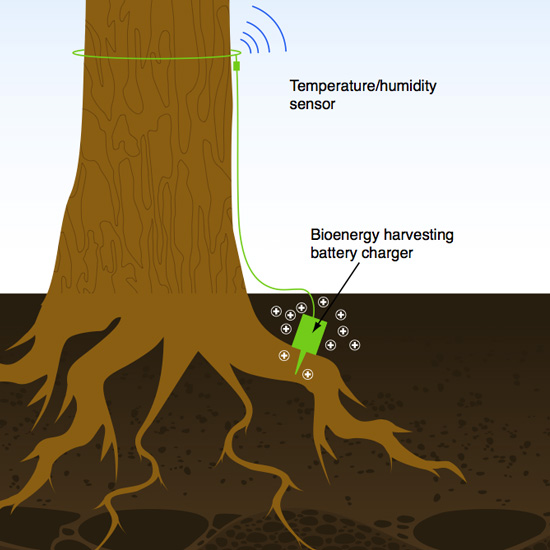
PROPOSAL: Harvest the metabolic energy of trees to power a maintenance-free, mesh-networked sensing system to predict and detect forest wildfires.
COUNTERPROPOSAL #1: Harvest the metabolic energy of trees to power a remote arboreal border homeland security system.
COUNTERPROPOSAL #2: Harvest the metabolic energy of trees to power an apparatus which acclimatizes a parcel from its present northern climes to conditions last seen when the area was straddling the equator, thus enabling the survival of formerly native tropical flora and fauna.
COUNTERPROPOSAL #3: Harvest the metabolic energy of trees to power concealed speakers sculpting the extinct sonic landscapes of a former ecosystem.
COUNTERPROPOSAL #4: Harvest the metabolic energy of trees to power mobile telecommunication devices long enough for passing hikers, park rangers and loggers to send a couple of tweets.
COUNTERPROPOSAL #5: Harvest the metabolic energy of trees to power fog machines which can be used, depending on your artistic persuasion, to render non-classically the very much classical scene of an aerosolized Jupiter raping Io, or equally classical scenes of wars and heroes, for instance, napalm defoliation during the Vietnam War.
Agro-veillance
Saturday, June 6, 2009


“Around Jerusalem,” write Adam Broomberg and Oliver Chanarin in Chicago, “acres of pine forest are used as popular family picnic spots. On the weekends they fill up with cars, people, pets, barbecues. But in the early mornings, just after dawn, the forests are completely silent, serene and untainted, giving the impression of timeless landscapes in which trees have been standing forever.”
But this apparent natural wilderness is a carefully constructed scene, as “many of these forests have been systematically planted on the expropriated land of Arab villages, which were forcibly evacuated and deliberately destroyed in 1948. It was not only sandy desert that was forested, but also cultivated olive groves and rural villages, the underlying intention being to obscure the locations of these villages so as to prevent any further cultivaton or re-settlement of the land by non-Jews.”
“These are places of erasure and amnesia.”
Monday, November 24, 2008
A lazy post for a lazy Monday, but hopefully you'll find it interesting. It's a short clip from Our Daily Bread, a feature-length documentary produced by Nikolaus Geyrhalter.
Having never wondered how pecans and walnuts are harvested on an industrial scale and then seeing how it's actually done for the first time, we were quite taken aback. It was as if discovering a new species of marine animal thriving in the violent hydrothermal whirlpools of some deep-oceanic trench — spectacularly ornamented, wondrously strange, marvelous.
Our reaction obviously says more about how far removed we are from the means of food production than anything about an inherent quality, but agricultural landscapes never fail to astonish us.
On agro


